Interdependent workflows
A single transaction could span weighing, identity checks, material rules, pricing, documentation, and accounting.


Recycling technology case study
A recycling technology provider needed to make a business-critical platform faster, more stable, and easier to integrate without disrupting the workflows its customers used every day.
The situation
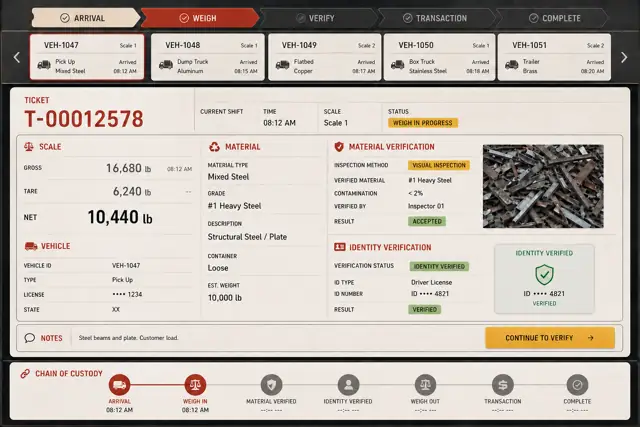
The platform connected vehicle weighing, material identification, pricing, transaction processing, reporting, and external business systems. Those workflows were central to daily operations, but slower response times and fragile integrations were creating avoidable friction.
Because the system also communicated with scales, identification devices, ERP tools, and customer systems, a clean replacement carried substantial operational risk. The client needed a controlled modernization path that preserved established behavior.
The challenge
The team had to understand how business rules, devices, and integrations behaved together before changing the platform.
A single transaction could span weighing, identity checks, material rules, pricing, documentation, and accounting.
Slow queries and tightly coupled components made everyday actions take longer and increased support effort.
Scale interfaces, ERP connections, and customer integrations had to remain dependable throughout the work.
The solution
The delivery team first mapped high-risk workflows and performance hotspots, then improved the platform in increments that operators could verify.
Trace each critical action from connected equipment through business rules, storage, and downstream reporting.
Refactor bottlenecks, improve data access, and separate fragile components behind clearer interfaces.
Standardize exchanges with business systems and hardware while adding better diagnostics for support.
How we worked
Engineers reviewed production-like workflows with domain specialists before changing high-risk areas.
Performance and integration changes were released in controlled increments so operators could validate behavior early.
Regression checks focused on the full transaction chain rather than isolated screens, reducing the chance of hidden downstream effects.
Map weighing, identity, pricing, and transaction paths.
Improve code and data access where delays originated.
Create clearer boundaries around devices and integrations.
Test complete operational scenarios before release.
The result
The documented modernization reduced response delays, strengthened stability, and made connected workflows easier to maintain without discarding proven business rules.
Incremental releases kept essential weighing and transaction workflows available during modernization.
Better component boundaries and diagnostics made issues easier to locate and resolve.
The platform could continue evolving without repeating the same tightly coupled patterns.
Case taxonomy
Modernize essential operations safely
Get in touch
Tell us what you need to build, modernize, automate, or augment with AI. We can start with a focused discussion or a no-risk 1-week trial.

“A fantastic company to work with.” After the initial rapid development project, American Shipping Co. kept two Shinetech developers embedded for nearly four years, supporting internal and external tools and new AI initiatives.
 CEO, American Shipping Co. - 5-star Google Review