Data integrity
Customer engine performance and operating records could not be lost or silently changed during migration.


Automotive manufacturing case study
An engine manufacturer needed to move customer performance and operating data from a legacy C++ application to C# with minimal disruption, no data loss, and room for continued functional change.
The situation
The manufacturer collected detailed performance and operating data on behalf of customers. That information supported analysis of how engines behaved under different conditions.
The existing C++ application needed to move to C# while the enterprise also updated its operating environment and continued adding functions. The migration requirements were explicit: minimize downtime and prevent data loss.
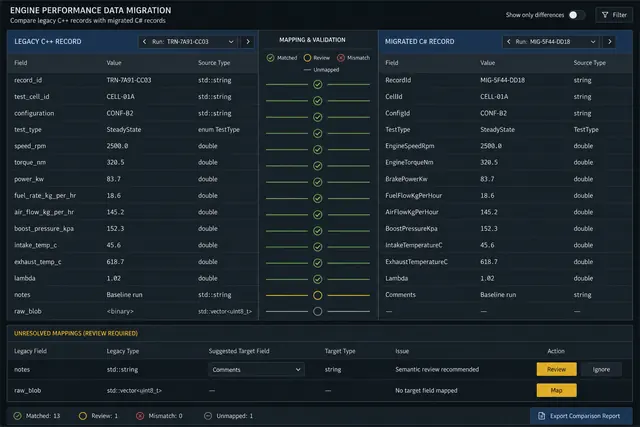
The migration challenge
The team had to understand the data, validate the target model, support a new operating environment, and keep new product needs in view.
Customer engine performance and operating records could not be lost or silently changed during migration.
The changeover needed to limit disruption while both application and operating environment evolved.
Migration work could not become a dead end; the new application still needed room for additional functions.
The solution
The team assessed the project’s complexity before selecting test methods, then used individualized scenarios and repeatable automation to protect delivery quality.
Compare C++ structures, operating records, dependencies, and target C# representations before moving information.
Use manual review for contextual scenarios and automated tests for repeatable migration and regression checks.
Use successful migration work as the basis for broader responsibility in business analysis, technical definition, and implementation.

How we worked
Pre-migration analysis determined that the project’s complexity required more than one form of validation.
Manual testing covered individualized operating and business scenarios, while automated testing provided repeatable coverage for migration and application behavior.
Clear delivery evidence allowed the relationship to expand beyond execution into requirement analysis and technical definition.
Map legacy data, application behavior, and migration risk.
Define the C++ to C# data and function path.
Combine manual scenarios with automated checks.
Extend responsibility into analysis and implementation.
The result
The source describes the migration as successful and documents an expansion of responsibility from delivery into business requirements, technical definition, and implementation.
The testing approach centered on the continuity and integrity requirements attached to customer operating records.
The new application foundation also supported the enterprise operating environment and further product functions.
Successful execution led the client to assign broader product and requirements responsibilities.
Case taxonomy
Protect the data behind modernization
Get in touch
Tell us what you need to build, modernize, automate, or augment with AI. We can start with a focused discussion or a no-risk 1-week trial.

“A fantastic company to work with.” After the initial rapid development project, American Shipping Co. kept two Shinetech developers embedded for nearly four years, supporting internal and external tools and new AI initiatives.
 CEO, American Shipping Co. - 5-star Google Review