Catalog maintenance
Users needed complete create, update, delete, detail, and search workflows.


Textile distribution case study
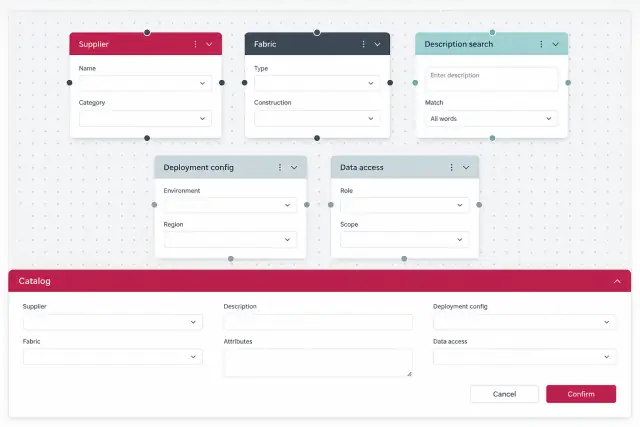
A distributor-facing system needed to maintain supplier and fabric records, expose useful product details, and support description search through reusable components.
The situation
Users needed to create, update, delete, review, and search supplier and fabric records.
The application also needed reusable components and configuration that could move between deployment environments without being embedded in each module.
The challenge
Supplier records, fabric details, search, configuration, and data access had to work as coordinated product capabilities.
Users needed complete create, update, delete, detail, and search workflows.
Reusable web parts had to communicate without becoming tightly coupled.
Environment-specific values needed to remain outside the application components.
The solution
Communicating web parts presented distinct capabilities while sharing a layered data foundation.
Support supplier and fabric create, update, delete, and detail workflows.
Help users find relevant product information through descriptive content.
Separate environment values from modular components and data access.
How the system was structured
Supplier and fabric components handled their own product responsibilities.
Description search connected users to the catalog without requiring them to know record identifiers.
Presentation, application, and data concerns were separated, while deployment configuration remained external to the modules.
Create and update supplier and fabric records.
Store useful product details.
Search catalog content by description.
Apply environment-specific settings externally.
The result
The documented system delivered catalog maintenance and description search through communicating .NET web components and a three-tier architecture.
Supplier, fabric, search, and data functions were separated into distinct responsibilities.
Description search provided a direct route into product information.
Presentation, application, and data access remained organized across three tiers.
Case taxonomy
Make product data easier to maintain and find
Get in touch
Tell us what you need to build, modernize, automate, or augment with AI. We can start with a focused discussion or a no-risk 1-week trial.

“A fantastic company to work with.” After the initial rapid development project, American Shipping Co. kept two Shinetech developers embedded for nearly four years, supporting internal and external tools and new AI initiatives.
 CEO, American Shipping Co. - 5-star Google Review