Device variation
Switches exposed management information and VLAN behavior differently.


Network management case study
A network-management provider needed one C# interface to read and configure ports and VLANs across switches that exposed different and sometimes incomplete MIB information.
The situation
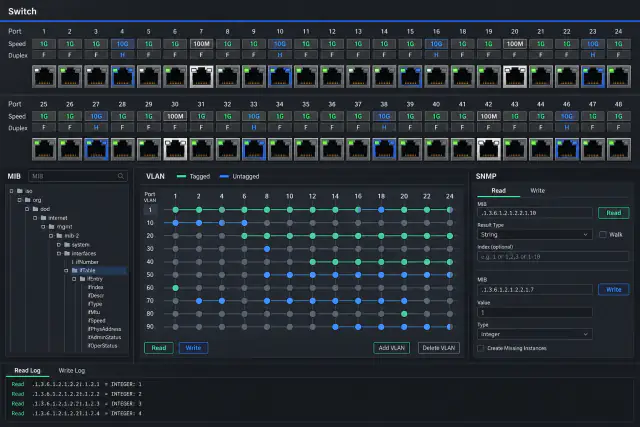
Operators needed to read basic device information, MAC and port data, speed, duplex, port status, and VLAN configuration without returning to separate command-line sessions.
They also needed to add or remove VLANs and place ports into tagged or untagged membership through a consistent product interface.
The challenge
The team had to understand device behavior and management structures deeply enough to map diverse switches into one interface.
Switches exposed management information and VLAN behavior differently.
Available documentation did not always describe every structure needed for configuration.
Reading status was not enough; the product also had to make controlled port and VLAN changes.
The solution
The team used management-information tools and observed device behavior to understand structures that were not fully documented.
Inspect available MIB data and compare it with known switch behavior.
Normalize device, MAC, port, speed, duplex, and VLAN information into one model.
Provide consistent port and tagged or untagged VLAN configuration through the C# interface.
How the work was structured
The team examined MIB structures with management tools and used existing device behavior to fill gaps where documentation was incomplete.
That understanding was encoded behind a common interface so operators did not need to learn each switch's command conventions.
Read and configuration behavior were brought together, covering both visibility and controlled changes to ports and VLAN membership.
Read MIB data and observe device behavior.
Map heterogeneous information into common fields.
Apply port and VLAN changes through SNMP.
Read the device state after the operation.
The result
The documented C# product unified device information, ports, speed and duplex, and tagged or untagged VLAN work through SNMP.
A common interface hid many differences in device-specific management structures.
Operators could inspect network state and make documented port and VLAN changes.
MIB tools and observed device behavior supported understanding where documentation was limited.
Case taxonomy
Unify heterogeneous device operations
Get in touch
Tell us what you need to build, modernize, automate, or augment with AI. We can start with a focused discussion or a no-risk 1-week trial.

“A fantastic company to work with.” After the initial rapid development project, American Shipping Co. kept two Shinetech developers embedded for nearly four years, supporting internal and external tools and new AI initiatives.
 CEO, American Shipping Co. - 5-star Google Review