Unstable property sets
Property names and ordering were not final, so a rigid form would be difficult to maintain.


Product information case study
A product-development organization needed to stop retyping emailed spreadsheets and documents into its enterprise database while preserving a familiar document-based way of working.
The situation
End users created and updated product information by emailing spreadsheets and word-processing documents. When the data was ready for the enterprise system, IT staff had to re-enter it into the database.
The client wanted to keep descriptions portable enough to email, save, compare, version, and share while constraining user choices so the structured result remained valid.
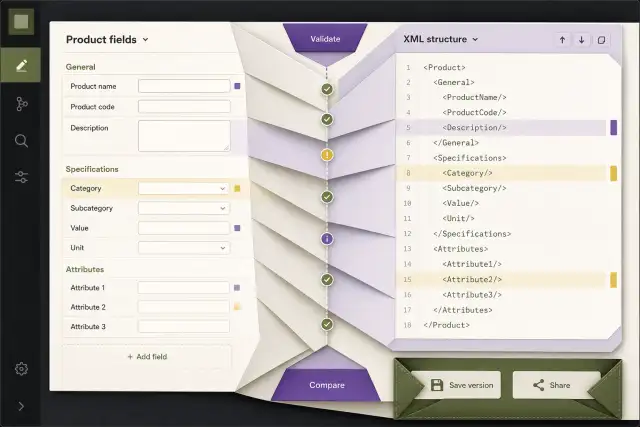
The challenge
The editor needed to guide nontechnical users while remaining flexible as enterprise object properties changed.
Property names and ordering were not final, so a rigid form would be difficult to maintain.
Users needed constrained choices and a simple interface rather than direct XML editing.
Descriptions had to remain independent enough to email, compare, version, and schedule before database import.
The solution
The client interface could open, create, edit, and save structured descriptions without asking end users to work directly with markup.
Define enterprise entity behavior in reusable JavaScript interfaces and implement it in focused entity classes.
Use XPath expressions to locate properties even when element names and order could change.
Treat product descriptions as documents that could be saved, emailed, compared, versioned, and scheduled for later import.
How we worked
The team first studied the cross-platform component environment supporting the user interface.
Object-oriented JavaScript kept enterprise entity contracts separate from individual implementations.
XPath literals were extracted into reusable constants so property matching could evolve without scattering fragile assumptions throughout the interface.
Define enterprise objects and reusable interface behavior.
Present constrained fields instead of raw XML.
Use XPath to match changing properties safely.
Save descriptions as portable, versionable documents.
The result
The documented application gave nontechnical users a guided interface while preserving the structured documents IT needed for dependable enterprise updates.
Constrained fields reduced the need for nontechnical staff to understand XML structure.
XPath-based matching accommodated changes in property names and order.
Descriptions could move through review and version control before the enterprise database was updated.
Case taxonomy
Make structured data easier to maintain
Get in touch
Tell us what you need to build, modernize, automate, or augment with AI. We can start with a focused discussion or a no-risk 1-week trial.

“A fantastic company to work with.” After the initial rapid development project, American Shipping Co. kept two Shinetech developers embedded for nearly four years, supporting internal and external tools and new AI initiatives.
 CEO, American Shipping Co. - 5-star Google Review