Changing criteria
Evaluation rules and forms needed to reflect updated requirements.


Education software case study
An education product needed continuous enhancement as evaluation criteria, reporting needs, and professional-development workflows changed.
The situation
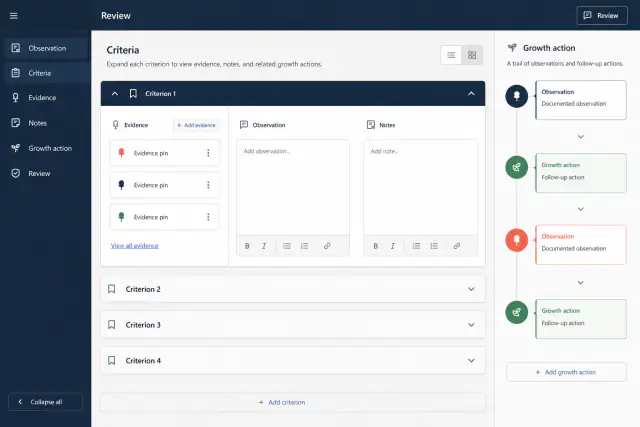
School administrators used the web product to evaluate teachers, analyze performance information, and connect observations with professional development.
Because evaluation criteria differed across education authorities and mandates, the platform needed ongoing changes rather than a one-time implementation.
The challenge
Criteria, data structures, and support requests could change independently, but they still had to behave as one coherent product.
Evaluation rules and forms needed to reflect updated requirements.
Observations, evidence, reporting, and development actions depended on shared records.
Enhancements, defects, backups, and support all had to be handled without fragmenting the product.
The solution
The work covered analysis, design, implementation, data handling, defect resolution, and operational care.
Clarify how revised criteria affected screens, workflows, data, and reports.
Add or adjust modules and functions within the existing ASP.NET application.
Resolve issues, support data retrieval, and keep backups and routine maintenance visible.
How the work was structured
The team traced updates across evaluation logic, interfaces, stored data, and downstream reporting before implementation.
Web services and asynchronous browser interactions supported connected functions, while the relational databases held evaluation and supporting information.
Enhancement and support work remained part of the same product context, which reduced the risk of a fix solving one screen while breaking another workflow.
Understand the revised evaluation requirement.
Identify affected criteria, data, and reports.
Implement the approved product change.
Resolve issues and maintain continuity.
The result
The documented engagement combined enhancement, data work, defect resolution, backup, and maintenance within one continuing product-engineering model.
Changes were considered across interfaces, data, and reports rather than as isolated form edits.
New and adjusted functions were delivered within the established application.
Defects, retrieval needs, backups, and maintenance were handled with product context.
Case taxonomy
Keep policy-driven software adaptable
Get in touch
Tell us what you need to build, modernize, automate, or augment with AI. We can start with a focused discussion or a no-risk 1-week trial.

“A fantastic company to work with.” After the initial rapid development project, American Shipping Co. kept two Shinetech developers embedded for nearly four years, supporting internal and external tools and new AI initiatives.
 CEO, American Shipping Co. - 5-star Google Review