Consistent league interpretation
Corrected mappings allowed equivalent provider inputs to follow the same calculation path.


Sports & Recreation · Subscription analytics
A subscription sports-analysis product standardized league inputs and aligned player scores with the client’s authoritative data while preserving existing member access and analysis workflows.
The business context
Fantasy football subscribers use player analysis to compare options within a particular league. Roster positions, scoring events, and the selected period all affect what a number means. The client’s product combined advanced player analysis with lineup tools and paid membership access.
A league imported from one provider needed to be interpreted consistently with an equivalent league from another. Meanwhile, an existing subscriber still needed to sign in, retain paid access, and use familiar analysis fields as the product evolved. Shinetech’s work addressed those relationships within a running service.
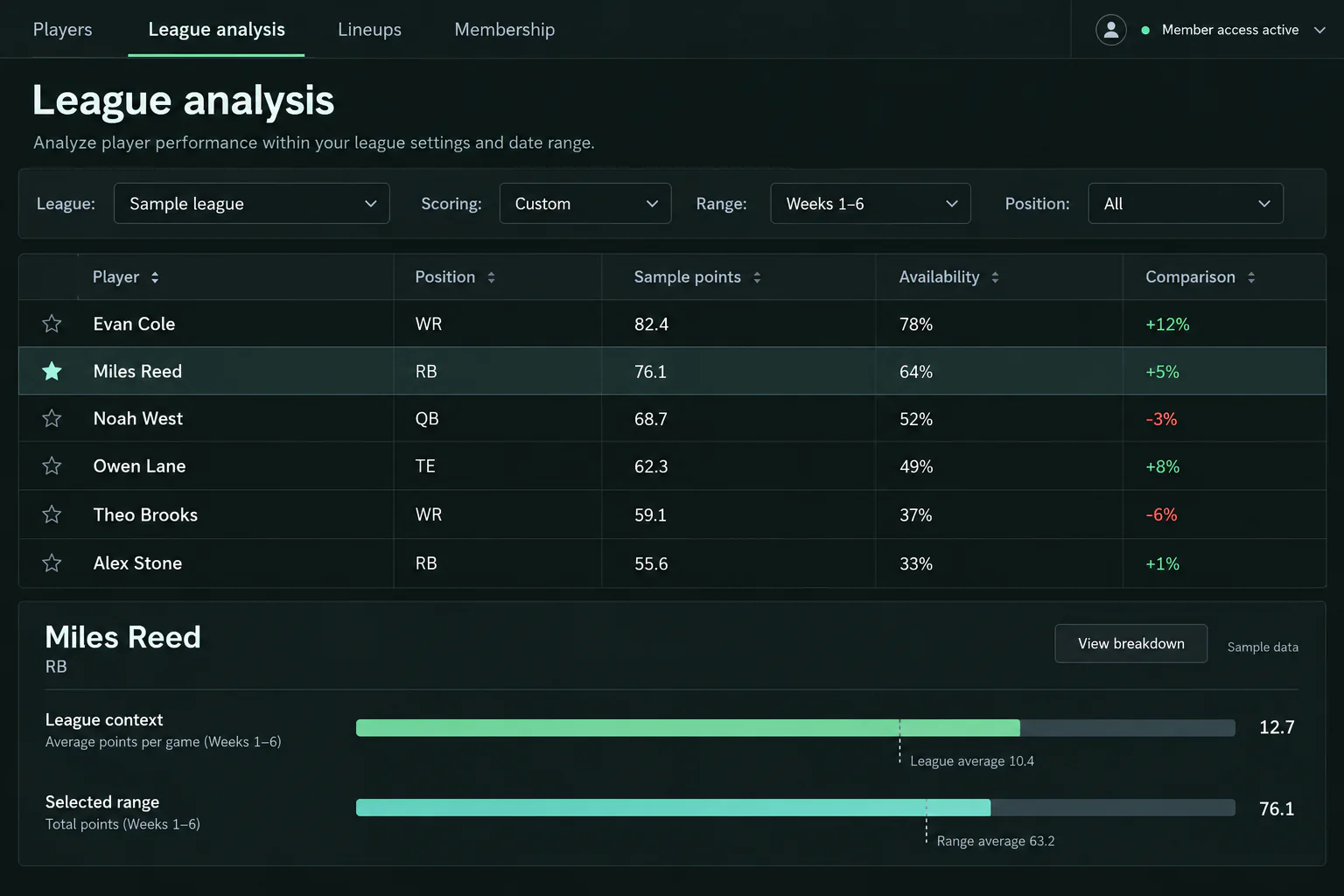
The interface uses invented players and values to illustrate league-aware analysis. It does not disclose the client’s formulas, reproduce licensed league data, or claim a competitive prediction outcome. View full-size interface (new tab)
The operating challenge
League providers expressed scoring events and player positions differently. Unmapped events or a position-specific rule could change the input to the same calculation, making a comparison unreliable before the analytical model even ran. Cache dimensions also had to match the context being analyzed.
Player scores presented a related but distinct issue. The client supplied authoritative full-season results, while users could also choose a shorter range of weeks. Recalculating everything independently risked drifting from the accepted season data; replacing the page with a fixed file would remove a useful interactive capability.
The delivery decisions
Provider-specific event codes, position rules, and scoring settings were mapped into a shared representation. The team checked equivalent leagues across providers and corrected the input interpretation, instead of adjusting individual player outputs to make a comparison look right.
Full-season values came from the client’s authoritative data file. Selected week ranges followed the agreed calculation specification. The implementation replaced the fields covered by that file while preserving the existing logic for unrelated fields and interactions.
The work also connected the newer frontend and services to the established API, database, and deployment environment. Existing users, subscription payments, and community-access roles remained part of the product, avoiding a separate migration burden for members.
How the workflow holds together
Checking two player scores is meaningful only after the league rules, positions, season, and week range have been aligned. The team used cross-provider league comparisons and the client’s accepted result data to validate those distinct paths through the application.
Changes moved through a staging environment for review before release to subscribers. That gave the client a place to confirm analysis behavior while also checking that login, paid access, and familiar page interactions still worked. The delivery scope was implementing and integrating the client’s analysis rules, not claiming ownership of its proprietary scoring methodology.
The delivered result
Corrected mappings allowed equivalent provider inputs to follow the same calculation path.
The application used the client’s authoritative full-season data while retaining interval-based analysis.
Existing accounts, subscriptions, and access workflows were preserved through the upgrade work.
The platform remains in use with continuing product development, supported by staging review and a release process that preserves existing member workflows.
Case taxonomy
Discuss your project
Tell us how your business works and where your software needs to change.
Get in touch
Tell us what you need to build, modernize, automate, or augment with AI. We can start with a focused discussion or a no-risk 1-week trial.

“A fantastic company to work with.” After the initial rapid development project, American Shipping Co. kept two Shinetech developers embedded for nearly four years, supporting internal and external tools and new AI initiatives.
 CEO, American Shipping Co. - 5-star Google Review