Localized experience
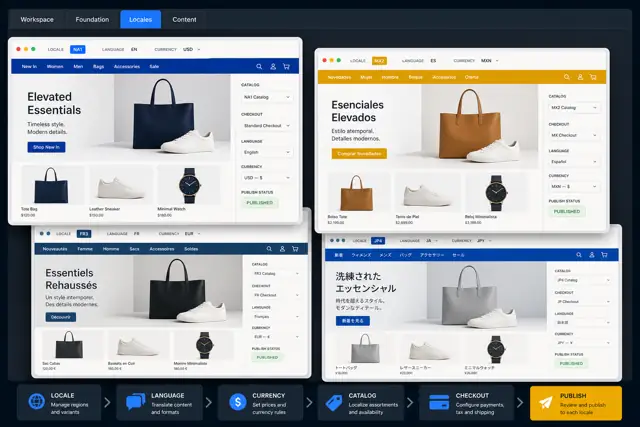
Language, content, merchandising, and checkout needed to feel appropriate in each market.


Global commerce case study
A global business needed a commerce platform that could launch efficiently in new markets while supporting localized content, customer journeys, and operational rules.
The situation
The client needed to present appropriate products, content, pricing, and checkout behavior in each market while maintaining one governable commerce foundation.
Launching separate sites independently would have repeated cost and inconsistency. The challenge was to create reusable capabilities without flattening meaningful local differences.
The challenge
The platform had to make repeated launches efficient while keeping market-specific configuration visible and manageable.
Language, content, merchandising, and checkout needed to feel appropriate in each market.
Core commerce behavior required consistency so the product did not fragment into unrelated sites.
New markets needed a predictable path from configuration and content through testing and release.
The solution
The team built core catalog and checkout behavior once, then created controlled configuration points for localized content, pricing, payment, and operational needs.
Establish common product, content, customer, and order capabilities across markets.
Create governed settings for language, currency, merchandising, checkout, and integrations.
Repeat configuration, testing, content readiness, and operational checks for each rollout.
How we worked
The initial launch tested both the customer experience and the operational process behind localization.
Product, content, and integration teams worked from one market-readiness checklist.
Lessons from the first rollout were converted into reusable configuration and validation practices for subsequent markets.
Build shared commerce and governance capabilities.
Configure content, catalog, currency, and checkout.
Test customer journeys and operating readiness.
Reuse the launch model for additional markets.
The result
The Magento platform combined consistent core capabilities with controlled local variation, helping the business enter additional markets without rebuilding the storefront each time.
Common capabilities reduced divergence between market storefronts.
Teams could focus on meaningful local differences instead of recreating the product.
A reusable checklist connected technical readiness with content and business preparation.
Case taxonomy
Build once, localize with purpose
Get in touch
Tell us what you need to build, modernize, automate, or augment with AI. We can start with a focused discussion or a no-risk 1-week trial.

“A fantastic company to work with.” After the initial rapid development project, American Shipping Co. kept two Shinetech developers embedded for nearly four years, supporting internal and external tools and new AI initiatives.
 CEO, American Shipping Co. - 5-star Google Review