External access
Agents and shippers needed purpose-built access to order functions.


Logistics case study
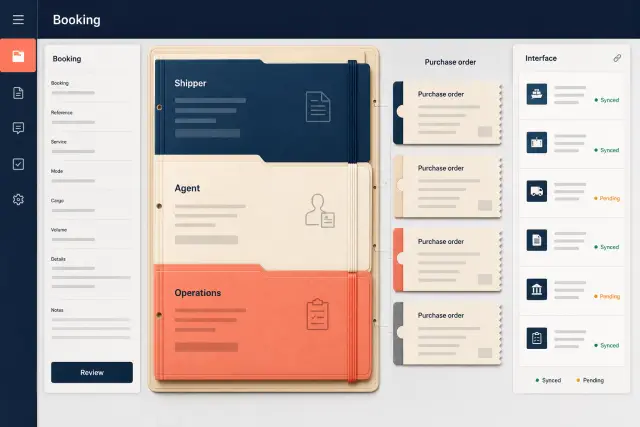
An order-management application complemented an existing logistics system with external booking and purchase-order access.
The situation
The existing environment supported internal customer and cargo information, but outside agents and shippers remained beyond its operational boundary.
The new application needed to complement that environment rather than replace it.
The challenge
Technical compatibility, third-party interfaces, and logistics rules were owned by different participants.
Agents and shippers needed purpose-built access to order functions.
New code and modules had to work with the internal logistics environment.
Engineering, coordination, interfaces, and business rules had separate owners.
The solution
The delivery team translated the available business rules into compatible modules and kept ownership boundaries explicit.
Separate logistics logic, third-party interfaces, coordination, and implementation.
Support order bookings and purchase-order management for authorized outside users.
Use requirement specifications and code review before handing over increments.
How the work was structured
The logistics specialists organized the business rules while the coordinating partner managed project and interface responsibilities.
The engineering team owned application development and prepared requirement specifications for planned work.
Regular review and code checks created a shared checkpoint before each delivery.
Define the next logistics and interface needs.
Turn the agreed work into implementable requirements.
Develop compatible order-management modules.
Check the code and delivery with stakeholders.
The result
The documented application let authorized outside users create bookings and manage purchase orders while complementing the existing internal system.
The new application extended the existing environment instead of replacing it.
External participants received the order functions documented in the source.
Requirement specifications and code review supported each increment.
Case taxonomy
Extend the systems your partners depend on
Get in touch
Tell us what you need to build, modernize, automate, or augment with AI. We can start with a focused discussion or a no-risk 1-week trial.

“A fantastic company to work with.” After the initial rapid development project, American Shipping Co. kept two Shinetech developers embedded for nearly four years, supporting internal and external tools and new AI initiatives.
 CEO, American Shipping Co. - 5-star Google Review