Growing variation
Different customers needed tailored functionality and interaction patterns.


CRM product-evolution case study
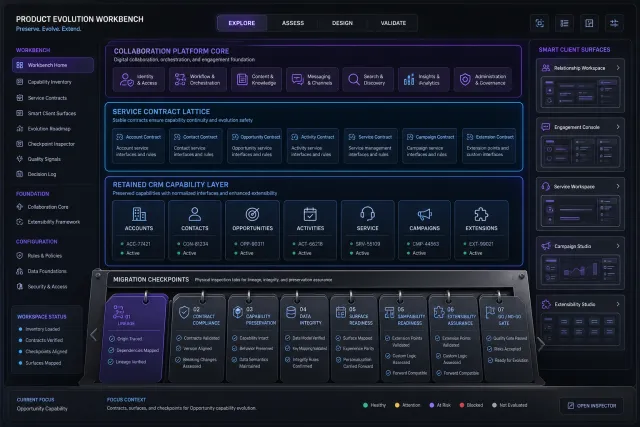
A CRM product evolved from a SharePoint foundation into a Windows smart-client and service-oriented architecture while retaining core relationship workflows and customer-specific extension points.
The situation
The product began with accounts, contacts, opportunities, activities, customer service, and campaigns on SharePoint.
As customer requirements and operating complexity expanded, the platform became a constraint on performance and extensibility.
The challenge
Product continuity, migration risk, interface flexibility, and extension safety all had to be managed together.
Different customers needed tailored functionality and interaction patterns.
The original collaboration platform became less suitable as the product expanded.
Core CRM workflows and accumulated extensions could not disappear during migration.
The solution
The team evolved the product in place, then moved the foundation when the accumulated evidence justified migration.
Map core CRM capabilities, customer extensions, data, interfaces, and dependencies.
Separate business capabilities behind service-oriented interfaces and web services.
Deliver Windows smart-client experiences while preserving the product’s accounts, contacts, opportunities, activities, service, and campaigns.
How the work was structured
Customer-specific work continued to build on the shared CRM product.
The platform recommendation followed observed product growth rather than a technology-only preference.
Service contracts and capability checks created a controlled route to the new client foundation.
Map capabilities and extensions.
Define stable service boundaries.
Move data and client surfaces.
Continue customer-specific releases.
The result
The documented evolution preserved core CRM functionality, introduced service-oriented boundaries, and moved the product from SharePoint to a Windows smart-client foundation.
Core relationship workflows remained central during migration.
Service contracts separated reusable capabilities from customer-specific surfaces.
The Windows and SOA model created room for continued product development.
Case taxonomy
Preserve product knowledge while changing the foundation
Get in touch
Tell us what you need to build, modernize, automate, or augment with AI. We can start with a focused discussion or a no-risk 1-week trial.

“A fantastic company to work with.” After the initial rapid development project, American Shipping Co. kept two Shinetech developers embedded for nearly four years, supporting internal and external tools and new AI initiatives.
 CEO, American Shipping Co. - 5-star Google Review