Large processing requirement
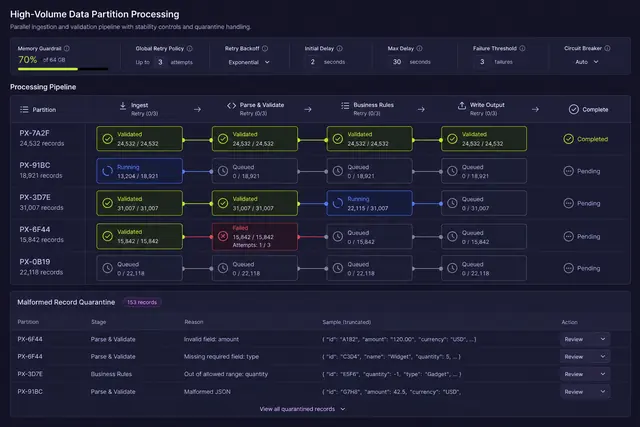
The system needed an architecture designed to remain stable across more than ten million records.


Data and analytics case study
A service company needed a .NET application that could process large client datasets, adapt to unpredictable requirements, and remain stable when working across more than ten million records.
The situation
The client’s service depended on processing substantial volumes of customer data. Stability at more than ten million records was a design requirement, not an optional later optimization.
At the same time, business requirements were complicated and difficult to predict. The delivery team had to improve its domain knowledge quickly enough to turn concise requests into sound architecture and data models.
The engineering challenge
Architecture quality, domain learning, development visibility, and early working software all mattered because no single fixed specification could remove the uncertainty.
The system needed an architecture designed to remain stable across more than ten million records.
Business needs could change before the team had complete domain context.
Short requests were difficult to interpret until developers understood the client’s data and service model.
The solution
The team optimized architecture, developed processing models, built domain knowledge, and exposed sprint progress so technical and delivery risk remained visible.
Treat stability and data volume as first-order design concerns while developing the application’s processing models.
Encourage developers to investigate the client’s context so concise requirements could be discussed accurately.
Use short sprints, burn-down visibility, and working software so the client could see status and emerging risk.

How we worked
The team worked in a dedicated collaboration environment with space for architecture and data discussions.
Working software was produced at the end of each short sprint so the client could assess real behavior and clarify the next requirement.
Progress, blockers, and delivery risk were communicated through shared sprint evidence, including burn-down information and advance notice when a commitment was at risk.
Build domain context around the client’s datasets.
Optimize architecture and develop processing models.
Review visible working software in short sprints.
Raise risk early and revise the next commitment.
The result
The source documents the architecture and delivery approach used to address changing requirements and a more-than-ten-million-record stability target; it does not provide a measured throughput result.
Data volume was considered while models and application structure were being developed.
Developers were expected to understand the client’s business context, not only implement isolated tickets.
The client could review sprint progress, working software, and delivery risk throughout the engagement.
Case taxonomy
Make data-system risk visible
Get in touch
Tell us what you need to build, modernize, automate, or augment with AI. We can start with a focused discussion or a no-risk 1-week trial.

“A fantastic company to work with.” After the initial rapid development project, American Shipping Co. kept two Shinetech developers embedded for nearly four years, supporting internal and external tools and new AI initiatives.
 CEO, American Shipping Co. - 5-star Google Review