Subtle defects
Potential issues could be small, irregular, and visually similar to acceptable surface variation.


Manufacturing quality AI case study
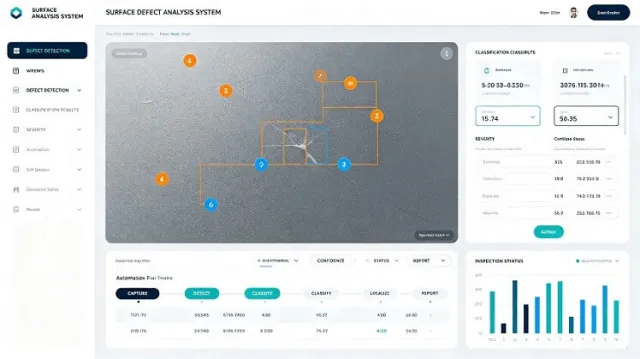
An AI vision workflow detected potential defects, localized affected regions, distinguished defect categories, and organized results for engineering review.
The situation
Small or irregular defects could appear in varied regions and forms across inspection imagery.
Engineers needed more than a pass-or-fail answer: the workflow had to show where a problem occurred and how it was classified.
The challenge
Detection, localization, category, and severity needed to remain visible to the engineer.
Potential issues could be small, irregular, and visually similar to acceptable surface variation.
Binary and multiclass models had to support different inspection decisions.
Results needed spatial context and organized reporting rather than an opaque model score.
The solution
The workflow connected image capture, detection, classification, localization, and reporting in one operational sequence.
Analyze inspection imagery and identify areas that may contain a surface defect.
Apply binary or multiclass models and show the affected region in context.
Organize defect distribution, severity, confidence, and review status for engineers.
How the work was structured
Visual overlays made the location of each candidate defect reviewable.
Classification results stayed connected to the image and inspection record.
Reporting supported follow-up and production-quality decisions without claiming autonomous acceptance.
Receive surface inspection imagery.
Find potential defect regions.
Determine the candidate category.
Inspect evidence and report.
The result
The documented system connected model output to spatial evidence and inspection reporting for quality-control decisions.
Outlined regions directed attention to the relevant surface area.
Binary and multiclass outputs supported different review needs.
Engineers reviewed model evidence before acting on the result.
Case taxonomy
Turn inspection imagery into reviewable quality evidence
Get in touch
Tell us what you need to build, modernize, automate, or augment with AI. We can start with a focused discussion or a no-risk 1-week trial.

“A fantastic company to work with.” After the initial rapid development project, American Shipping Co. kept two Shinetech developers embedded for nearly four years, supporting internal and external tools and new AI initiatives.
 CEO, American Shipping Co. - 5-star Google Review