Complex availability
A valid time depended on staff, space, material, and rental-resource constraints.


Hospitality software case study
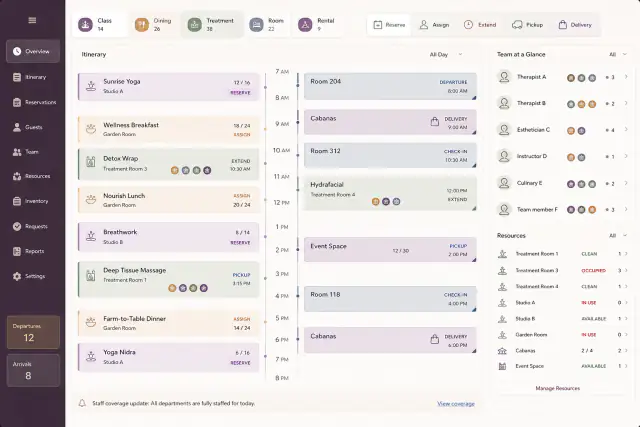
A day-spa operation needed to coordinate services, classes, dining, staff, property resources, and rental inventory in one reservation workflow.
The situation
The operation combined spa services with classes, dining, property use, and rentable resources such as watercraft, seating, lockers, and cabanas.
Each reservation could require qualified staff, materials, rooms, pickup or delivery actions, and data shared with existing property and point-of-sale systems.
The challenge
Availability, qualifications, inventory, roles, and external interfaces had to stay synchronized as bookings changed.
A valid time depended on staff, space, material, and rental-resource constraints.
The new module needed to work with property and point-of-sale integrations.
Reserve, assign, cancel, reinstate, extend, pickup, and delivery actions affected several records.
The solution
The team modeled the operational rules, separated presentation and business logic, and connected external services through defined interfaces.
Map services, employees, groups, materials, resources, roles, and actions.
Coordinate availability, assignment, changes, reminders, pickup, and delivery.
Use web services and process interfaces while abstracting data access across relational databases.
How the work was structured
Early prototypes and demonstrations gave stakeholders a concrete way to review difficult booking rules.
The team prioritized high-risk behavior, then refined the product through repeated implementation, feedback, and validation.
Layered design separated interface, business behavior, and persistence, while web-service and process integrations connected the surrounding property systems.
Map reservation types and resource rules.
Make difficult interactions visible early.
Connect scheduling with existing interfaces.
Use demonstrations and feedback to adjust behavior.
The result
The documented solution combined complex reservation actions and operational dependencies within a maintainable, layered application.
Bookings could include the people, spaces, materials, and rental resources needed to fulfill them.
Changes such as extension, pickup, delivery, cancellation, and reinstatement stayed in the workflow.
Iterative demonstrations made difficult rules visible before final implementation.
Case taxonomy
Coordinate the whole service operation
Get in touch
Tell us what you need to build, modernize, automate, or augment with AI. We can start with a focused discussion or a no-risk 1-week trial.

“A fantastic company to work with.” After the initial rapid development project, American Shipping Co. kept two Shinetech developers embedded for nearly four years, supporting internal and external tools and new AI initiatives.
 CEO, American Shipping Co. - 5-star Google Review