Interdependent modules
Customer, quotation, warehouse, and service workflows shared data and could not be changed in isolation.


Semiconductor ERP case study
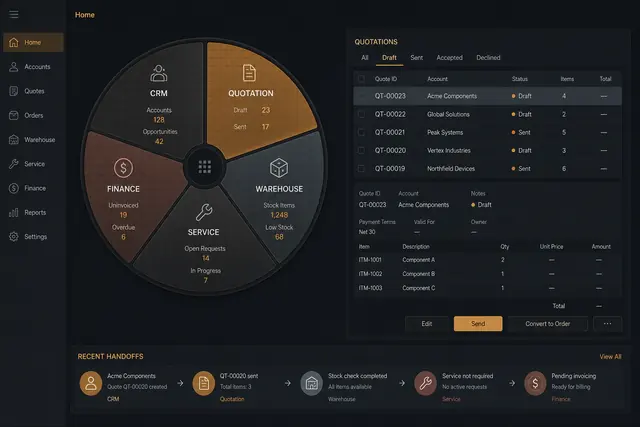
A semiconductor manufacturer needed distributed teams to extend a modular ERP covering customer, quotation, warehouse, and service-order workflows while requirements continued to change.
The situation
The platform consisted of many modules, including customer relationship management, quotation management, warehouse management, and service-order tracking.
Because requirements changed regularly, teams working in different locations needed a delivery model that made work small enough to estimate, visible enough to coordinate, and clear enough to deploy into a shared enterprise product.
The coordination challenge
The engineering work had to connect business analysis, technical decisions, story sizing, delivery visibility, and integration into one repeatable cadence.
Customer, quotation, warehouse, and service workflows shared data and could not be changed in isolation.
Priorities and details continued to move even while planned work was underway.
Several teams needed enough shared context and visibility to contribute without creating integration surprises.
The solution
The team combined business and technical requirement elaboration with small work items, regular communication, and recurring code delivery.
Keep work compact enough to estimate, discuss, and revise when a business priority changes.
Contribute analysis at both the business and technology levels before implementation decisions harden.
Use frequent team contact and concise progress reporting so dependencies and changes remain visible.

How we worked
Rather than treating a long iteration plan as fixed, the team adjusted individual stories when requirements changed.
Short work items improved estimation and made the cost of a change easier to understand before it spread across modules.
Frequent communication kept the client close to each team member, while recurring delivery gave the client a dependable point for deployment and continuous integration.
Elaborate the business and technical requirement.
Turn the change into a compact user story.
Implement within the relevant ERP module.
Deliver code into the client’s deployment and integration process.
The result
The documented delivery model supported a broad .NET and SQL Server ERP by combining short stories, requirements collaboration, frequent communication, and recurring code delivery.
Requirement analysis was not left entirely to the client; the delivery team contributed at both levels.
Small stories reduced the disruption created when a priority shifted during planned work.
Regular progress communication helped distributed contributors stay aligned around one evolving platform.
Case taxonomy
Coordinate complex product change
Get in touch
Tell us what you need to build, modernize, automate, or augment with AI. We can start with a focused discussion or a no-risk 1-week trial.

“A fantastic company to work with.” After the initial rapid development project, American Shipping Co. kept two Shinetech developers embedded for nearly four years, supporting internal and external tools and new AI initiatives.
 CEO, American Shipping Co. - 5-star Google Review