Model multiple workload channels
Organize inbound calls, email, and related operational data so statistical methods could produce useful workload forecasts.


Workforce-management case study
A workforce-management software team partnered with Shinetech to turn proven statistical forecasting methods into a cloud application for contact-center workload and staffing planning.
The situation
Customer-service organizations need to anticipate changing volumes across inbound calls, email, and other workload channels. Those forecasts directly influence how much capacity teams need at different times.
The client brought deep workforce-management expertise and proven statistical methods. The missing piece was a practical cloud product that could make those methods accessible without relying on time-consuming spreadsheet work.
The challenge
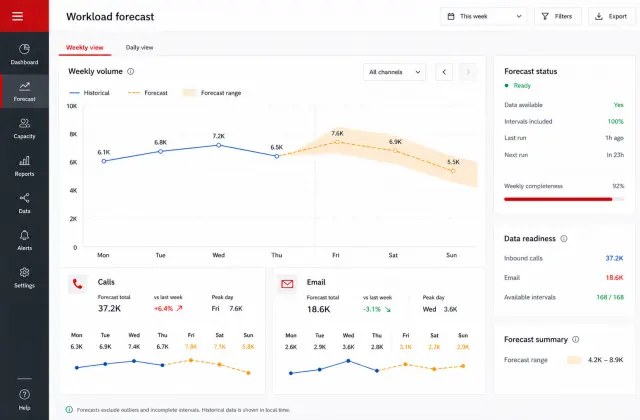
The product needed to preserve the client’s forecasting logic while making data preparation, forecast generation, and staffing decisions easier to manage in one web workflow.
Organize inbound calls, email, and related operational data so statistical methods could produce useful workload forecasts.
Present forecast demand in a form that customer-service leaders could use when planning workforce capacity.
Replace a manual, hours-long process with a cloud workflow designed for repeatable use and broader availability.
The solution
Shinetech helped shape the product roadmap, select appropriate platforms, establish the hosting environment, and manage delivery from the initial design through working releases.
Structure workload inputs so calls, email, and time-based demand could be prepared consistently for forecasting.
Bring the client’s established statistical methods into a repeatable application workflow without changing their central purpose.
Use the selected SharePoint and hosting environment to make forecasts and staffing requirements accessible through a practical web interface.

How we worked
Shinetech introduced Agile and Scrum practices so both teams could turn the product concept into prioritized increments and review progress throughout development.
Together, the teams created product roadmaps and a release sequence. Shinetech also supported technology selection, hosting setup, and day-to-day software delivery.
This collaborative model gave the client visibility into decisions and created a foundation for continued product releases after the initial launch.
Turn the product vision into a roadmap.
Sequence features and releases.
Deliver working cloud increments.
Review feedback and release improvements.
The result
The launched application gave contact-center teams a clearer alternative to spreadsheet-based forecasting and made sophisticated workforce-planning methods easier to use through the cloud.
Forecast generation became a repeatable web workflow instead of a manual process assembled across separate files.
The product linked incoming customer-service demand with the staffing requirements operations teams needed to plan.
The client continued working with Shinetech to evolve the product after launch and highlighted the team’s communication, delivery speed, and work quality.
Case taxonomy
Turn specialized knowledge into software
Get in touch
Tell us what you need to build, modernize, automate, or augment with AI. We can start with a focused discussion or a no-risk 1-week trial.

“A fantastic company to work with.” After the initial rapid development project, American Shipping Co. kept two Shinetech developers embedded for nearly four years, supporting internal and external tools and new AI initiatives.
 CEO, American Shipping Co. - 5-star Google Review