

Customer Service · Omnichannel Intake case study
Connecting service channels around a Salesforce case
One customer may email, submit a web form and call about the same issue. This case focuses on recognizing that continued inquiry across channels before routing the case with its history intact.
The situation
Every contact channel started a new version of the problem
A customer could email, submit a web form and call about the same issue. Each channel created a separate trail, so agents compared names, copied notes and asked customers to repeat information that already existed elsewhere.
Channel choice was convenient for customers but fragmented for the service team.
The challenge
The team needed continuity without unsafe matching
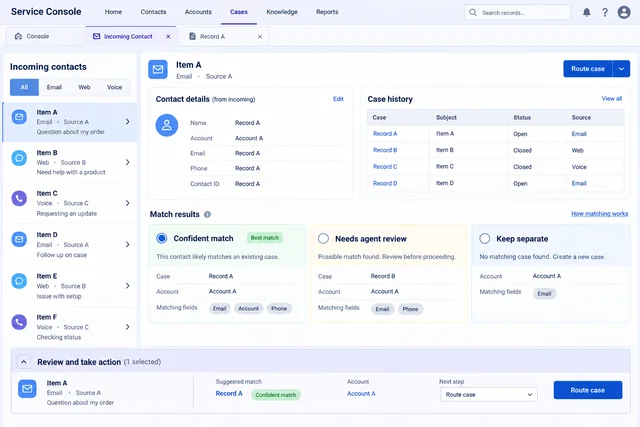
Email addresses, order references and caller details were not always complete or identical. Matching had to avoid joining unrelated people, and routing needed to preserve the original context while directing the case to the right queue.
The solution
Each contact channel continued the same service record
Available customer and request identifiers help agents recognize a continuing inquiry; uncertain matches need review before records are joined.
Email, web and phone contacts use available customer and request identifiers to find the relevant case. A confident match can continue the existing inquiry; an uncertain match needs agent review. Routing then directs the case to the appropriate team with its channel context.
A web form can capture the identifiers and outcome needed for follow-up.
A phone conversation can use those identifiers to find or start the relevant case.
How we work
Prove continuity one channel at a time
The busiest intake path was documented first, including the identifiers customers actually supplied and the duplicate cases it created. The intake design can then be checked across email, web and voice against the same case history.
For each added channel, the team reviewed a clear match, an incomplete reference and a possible false match. Uncertain contacts are left for agent review rather than assumed to be a match. Case outcomes then informed changes to forms, routing and matching rules.
Three test contacts for every channel
| Test contact | What should happen |
|---|---|
| A clear match | The contact continues the existing case with its history. |
| An incomplete reference | The likely case is found where the identifiers allow; the gaps stay visible to the agent. |
| A possible false match | The records stay separate until an agent reviews them. |
The result
One inquiry could continue when the customer changed channel
Customer
An email, web request or call can continue the existing inquiry when the identifiers support a confident match.
Service team
Agents and supervisors work from the case history and ownership view instead of reconstructing the same issue from separate channel trails.
Uncertain matches remain visible for review, protecting the continuity of a real case without joining unrelated customers. Case continuity depends on the available identifiers and the review of uncertain matches.
Case taxonomy
Explore the industry, technology, and business need.
Industry and product
- Cross-Industry
Technology and delivery
- Service Cloud
- Omni-Channel
- Email-to-Case
Business need
- Omnichannel Intake
- Case Matching
- Queue Routing
- Duplicate Prevention
Discuss your business systems
Need Salesforce to fit the way your team works?
Get in touch
Ready to build software that fits your business?
Tell us what you need to build, modernize, automate, or augment with AI. We can start with a focused discussion or a no-risk 1-week trial.

“A fantastic company to work with.” After the initial rapid development project, American Shipping Co. kept two Shinetech developers embedded for nearly four years, supporting internal and external tools and new AI initiatives.
 CEO, American Shipping Co. - 5-star Google Review