Focused store access
The portal reduced the number of NetSuite user licenses required for store employees and lowered the associated license costs.


Retail · NetSuite Operations case study
NetSuite extensions connect orders, store replenishment, receiving, returns, and intercompany finance, with a dedicated retail portal.
The situation
A retail business used NetSuite alongside e-commerce, physical-store, wholesale, warehouse, and returns platforms. Orders and inventory crossed those systems, while store employees needed a simpler way to replenish and receive stock.
Finance also needed to correct customer balances and intercompany accounts. The work covered the operational records behind those issues as well as the interfaces and custom scripts that moved them.
The challenge
A single order could involve partial shipments, inventory updates, a return authorization, and product-specific accounting. Tax differences between the commerce platform and NetSuite had also affected customer balances.
Store staff needed only selected replenishment and receiving functions. Requiring the full NetSuite interface and individual system licenses made that narrow task more costly and harder to use.
The solution
Shinetech upgraded existing SuiteScript code, added unit tests, and implemented Playwright tests for critical NetSuite business processes. These checks covered both code logic and system-level operations.
Custom scripts supported the client’s order-splitting and partial-shipment rules. A Scheduled Script corrected affected customer balances caused by differences in Shopify and NetSuite tax calculations. The Custom GL Lines Plug-in mapped selected SKUs to the required general-ledger accounts.
Celigo flows were configured and refined for four documented data paths.
| Direction | Business records |
|---|---|
| NetSuite → Shopify | Items |
| Shopify → NetSuite | Sales orders and customers |
| 3PL → NetSuite | Inventory |
| Returns platform → NetSuite | Return authorizations |
How the work was structured
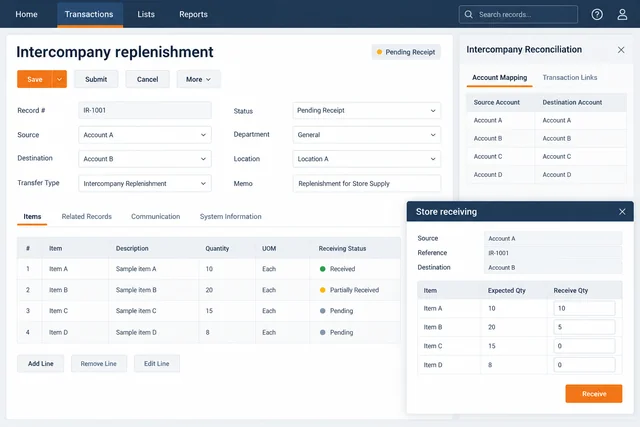
NetSuite intercompany orders supported store replenishment between subsidiaries. Shinetech built a dedicated Retail Portal using Custom Records, Suitelet, and SuiteQL, with Vue and Tailwind CSS for its interface.
The portal exposed the required data and business processes so store employees could complete replenishment and receiving without signing directly into NetSuite. Its screens were shaped around store tasks instead of the full ERP navigation.
Finance operations
NetSuite AI Connector and custom script-based tools connected an AI agent to data queries, lightweight reports, and journal-entry creation through conversation. The documented path ran from the agent through the integration and connector to custom tools and the journal entry.
Advanced Intercompany Journal Entries were also used to offset reciprocal intercompany accounts payable. That work helped finance correct affected financial statements and intercompany reconciliations.
The result
The portal reduced the number of NetSuite user licenses required for store employees and lowered the associated license costs.
Commerce, warehouse, and returns flows carried the records needed for order processing and stock visibility.
Customer-balance and intercompany work addressed the affected balances and reconciliations, while product-specific account mapping supported the required accounting treatment.
Unit and business-process tests provided repeatable checks for continued maintenance of the customized environment.
Case taxonomy
Discuss your business systems
Get in touch
Tell us what you need to build, modernize, automate, or augment with AI. We can start with a focused discussion or a no-risk 1-week trial.

“A fantastic company to work with.” After the initial rapid development project, American Shipping Co. kept two Shinetech developers embedded for nearly four years, supporting internal and external tools and new AI initiatives.
 CEO, American Shipping Co. - 5-star Google Review