Connected entities
Properties, tenants, units, leases, banks, vendors, and documents shared references.


Real estate software case study
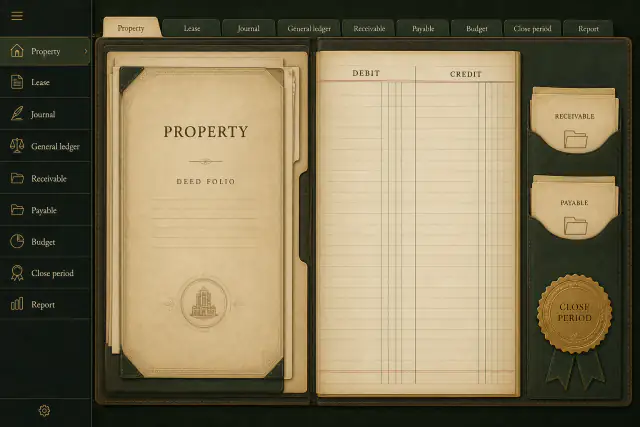
A real estate operator needed one rule-aware accounting product for property structures, commercial leases, banking, journals, general ledger, receivables, payables, closing, and reports.
The situation
Properties were organized through legal entities, buildings, floors, units, tenants, leases, and bank accounts.
Financial work then extended through journals, the general ledger, budgets, accounting periods, receivables, payables, vendors, invoices, receipts, write-offs, checks, reports, and closing.
The challenge
Permissions, validation, period status, balanced entries, and document relationships had to work across a large connected product.
Properties, tenants, units, leases, banks, vendors, and documents shared references.
Balanced debits and credits, unique documents, valid periods, and closing rules required consistent enforcement.
Users needed roles and property-level permissions rather than unrestricted access to every record.
The solution
The application combined shared data, validation, role controls, reports, and import and export functions across the accounting lifecycle.
Model entities, buildings, floors, units, tenants, commercial leases, and bank relationships.
Link journals, general ledger, budgets, receivables, payables, invoices, receipts, checks, and write-offs.
Enforce role and property scope, validate accounting rules, manage periods, and deliver operational reports.
How the work was structured
The source describes detailed field rules, relationships, validations, permissions, and process behavior across the product rather than only a screen list.
A layered .NET design separated the user interfaces and services from data behavior, while SQL Server and reporting services supported persistence and output.
Import, export, internationalization, and property-scoped role controls were treated as product capabilities alongside journals, receivables, payables, and closing.
Define properties, leases, units, and banks.
Create journals, invoices, receipts, and checks.
Validate balances, periods, roles, and scope.
Review ledgers, budgets, receivables, and payables.
The result
The documented system connected operational real estate records with accounting workflows, reporting, and scoped controls in a shared application.
Tenant, unit, lease, bank, vendor, and document records were connected instead of maintained as isolated lists.
Balance, uniqueness, period, and document validations formed part of the documented behavior.
Roles and property assignments determined which information and actions a user could reach.
Case taxonomy
Connect real estate operations and accounting
Get in touch
Tell us what you need to build, modernize, automate, or augment with AI. We can start with a focused discussion or a no-risk 1-week trial.

“A fantastic company to work with.” After the initial rapid development project, American Shipping Co. kept two Shinetech developers embedded for nearly four years, supporting internal and external tools and new AI initiatives.
 CEO, American Shipping Co. - 5-star Google Review