Many functions
Transactions, communication, reporting, and administration belonged in one product.


Commerce platform case study
A Java commerce application organized customer transactions, operational roles, reporting, and system administration within one layered product.
The situation
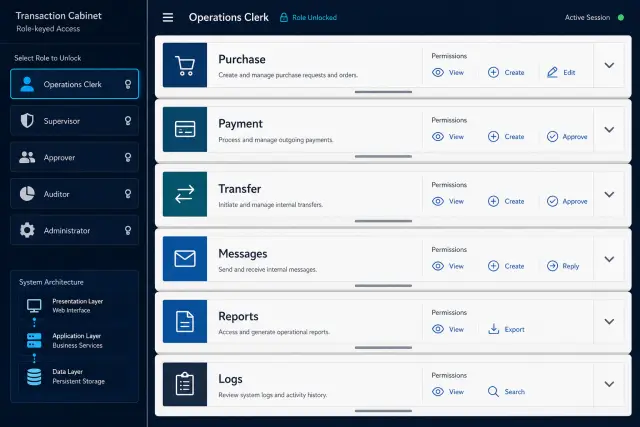
The required scope went beyond a storefront. It included purchases and payments, account transfers, messages, statistics, reports, system management, and log management.
Different participants also needed distinct permissions based on their responsibilities.
The challenge
The application had to connect customer-facing functions with operational duties and technical administration.
Transactions, communication, reporting, and administration belonged in one product.
Customers, operational staff, and administrators needed different permissions.
Presentation, business logic, and persistence needed explicit separation.
The solution
The team covered requirements, framework and database design, interface design, implementation, and testing.
Assign purchase, payment, transfer, accounting, remittance, and administration responsibilities.
Use JSP and Struts for presentation, business objects for logic, and iBatis DAO for persistence.
Include messages, statistics, reports, system management, and logs around the transaction flow.
How the work was structured
Requirements analysis established the transaction functions and the responsibilities of each user group.
Framework, database, and interface design translated that model into a layered Java architecture.
Implementation and testing covered both customer activity and administrative work.
Define functions, roles, and permissions.
Shape the framework, database, and interface.
Build the layered Java application.
Exercise transaction and administration paths.
The result
The source records a Java web application spanning customer purchases, payments, transfers, messages, reporting, logs, and distributed administration.
Customer and administrative capabilities were delivered within the same application.
Roles limited which responsibilities each participant could perform.
Presentation, business, and persistence concerns were separated.
Case taxonomy
Connect complex transaction responsibilities
Get in touch
Tell us what you need to build, modernize, automate, or augment with AI. We can start with a focused discussion or a no-risk 1-week trial.

“A fantastic company to work with.” After the initial rapid development project, American Shipping Co. kept two Shinetech developers embedded for nearly four years, supporting internal and external tools and new AI initiatives.
 CEO, American Shipping Co. - 5-star Google Review