Reviewed content
Submissions, classification, publishing, and removal were managed through the administration tools.


Healthcare · Medical knowledge services
A medical information platform connected contributor submissions, editorial review, and knowledge discovery across a mobile app, a WeChat mini program, and a shared administration workspace.
The business context
The client wanted to bring medical and health information to both professional readers and the public. Its content included first-aid knowledge, medical terms, videos, online courses, and live streams. These formats offered different ways to learn, but they also created an ongoing task for the people organizing and publishing them.
The project brought a mobile app, a WeChat mini program, and administration tools into one information-service platform. Its central workflow connected the organizations and individuals supplying content with the editors managing publication and the readers looking for relevant knowledge.
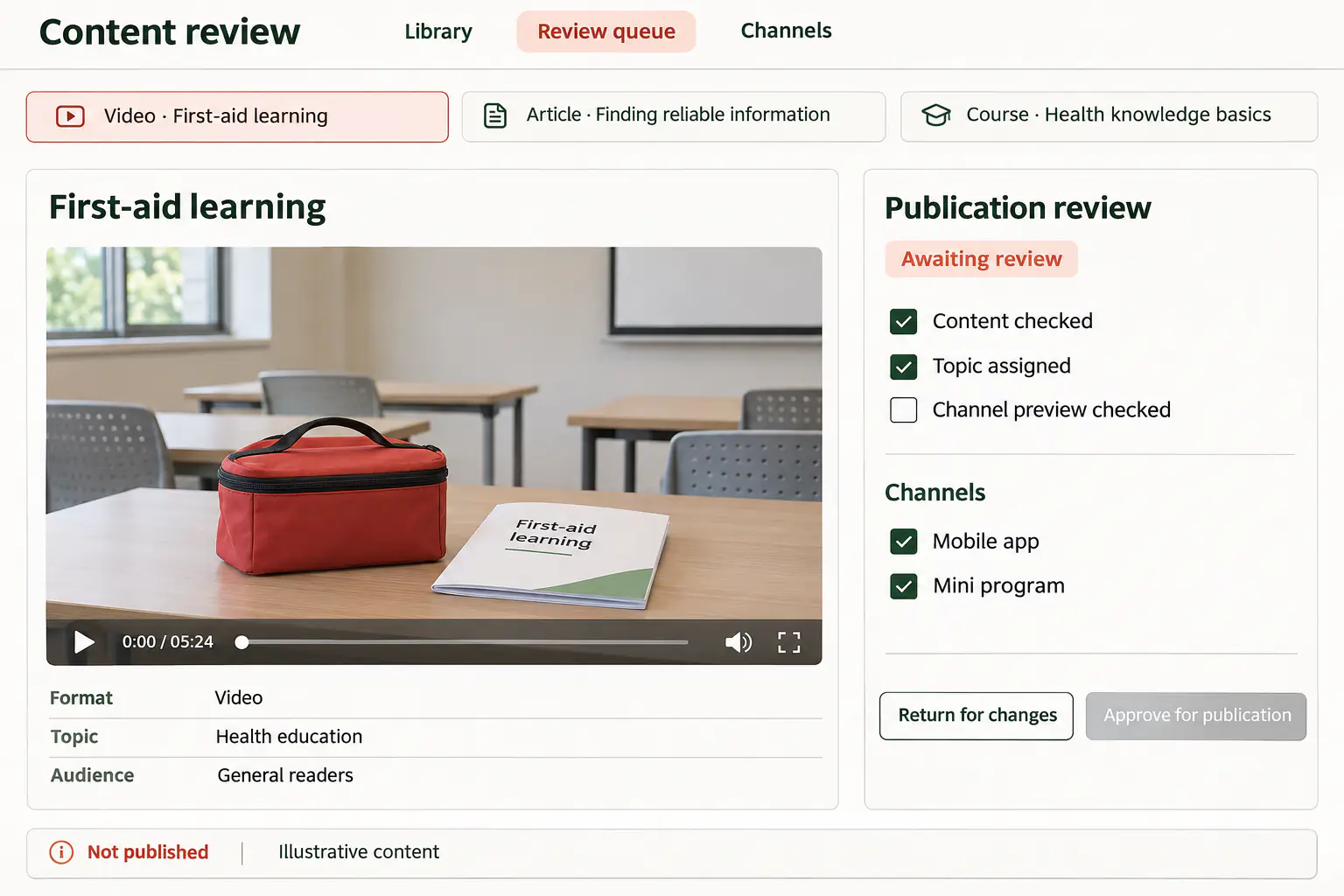
Concept reconstruction with invented educational content and review states. It illustrates editorial decisions and delivery channels, not a customer interface or medical guidance. View full-size interface (new tab)
The operating challenge
A course submission, a video, and a medical reference entry are different editorial objects. The platform needed to organize those formats without leaving contributors, editors, and readers with separate, disconnected processes. Classification and review had to support the publishing work as well as the user-facing library.
The audiences also arrived with different needs. A professional looking for a particular topic and a member of the public browsing educational material might use different routes through the same service. Search, categories, and recommendations needed to help people reach the appropriate content while editors retained control over what was available.
The delivery decisions
Organizations and individual creators could submit content for editorial review. The administration tools supported classification, publication, and removal, making the status of material part of the content operation.
The platform brought knowledge entries, videos, courses, and live streams into a shared operating framework. App and mini-program interfaces provided access, while the backend supported content, course, and user administration.
Search, topic navigation, and recommendations supported content discovery. Browsing, saved items, and learning preferences could inform recommendations, helping readers continue exploring the knowledge resources available to them.
The working detail
The contributor provides material; the editor decides how it is classified and whether it is published. Search and recommendation features then help readers discover the available content. A useful recommendation depends on a maintained collection and a clear publishing process.
The platform's operating tools connected those responsibilities with course information, user accounts, and content activity. That gave the service team a way to maintain the library as material changed, with an explicit route for removing content as well as adding it. The product is an information and education service, not a diagnostic or treatment system.
The delivered result
Submissions, classification, publishing, and removal were managed through the administration tools.
Knowledge entries, video, courses, and live streams formed one information service.
Search, navigation, and recommendations provided different routes into the available material.
The documented result is delivery of the information-service platform and its content workflows. No clinical outcome or measured audience-growth claim is attached to this case.
Case taxonomy
Discuss your project
Tell us how your business works and where your software needs to change.
Get in touch
Tell us what you need to build, modernize, automate, or augment with AI. We can start with a focused discussion or a no-risk 1-week trial.

“A fantastic company to work with.” After the initial rapid development project, American Shipping Co. kept two Shinetech developers embedded for nearly four years, supporting internal and external tools and new AI initiatives.
 CEO, American Shipping Co. - 5-star Google Review