

Construction · B2B Commerce case study
Connecting jobsite ordering and delivery with Salesforce Commerce
A contractor selects a panel kit and requests delivery to a jobsite. Shinetech used Salesforce Commerce to connect that order journey to account eligibility, branch fulfillment and transport capacity before the customer saw a delivery choice.
The situation
The customer needed a delivery choice operations could honor
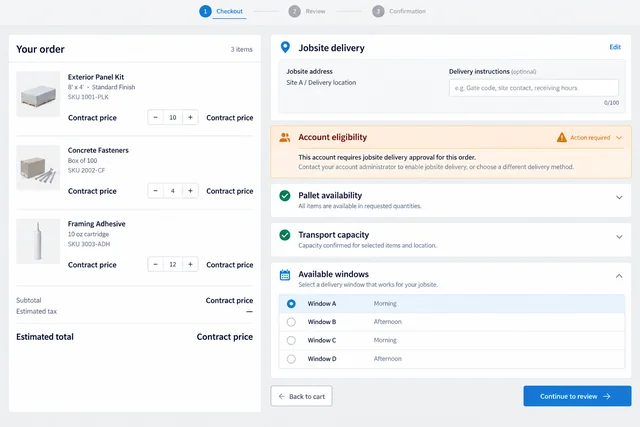
In the example order path, a contractor selects a panel kit and requests early-morning jobsite delivery. The account may be on credit hold, the branch may fulfill by pallet rather than unit, and the delivery window may require a boom truck.
On a jobsite, material delivery affects crew schedules, unloading equipment and the next stage of work. A product being in stock is only part of the decision. If account or transport constraints emerge after checkout, the customer may need to revise both the order and the site plan.
The challenge
A sellable product still needed a workable jobsite delivery
The customer starts with a product and delivery need in Commerce. The ERP owns credit status, branch inventory owns the sellable pallet quantity, and transport scheduling owns specialist vehicle capacity. The order journey needed one answer that reflected all three decisions before a delivery window was promised.
The solution
Shinetech connected the buying journey to fulfillment decisions
Salesforce Commerce held the account and basket context for the buyer. Shinetech connected that context to ERP credit, branch stock and transport decisions, so the available checkout choices reflected the conditions needed to fulfill the order.
Translate the basket into the branch’s pallet fulfillment unit and check availability.
Offer delivery windows that fit the load, vehicle and jobsite requirements.
How we work
Verify the whole order decision, not three isolated APIs
Shinetech mapped the path from a contractor’s basket through credit, pallet availability and transport scheduling. Each response retained its system owner and a recovery path, so Commerce could explain why a delivery option was unavailable or had changed.
The order path is illustrated with a credit hold, a pallet conversion, unavailable specialist equipment and a changed delivery window. The end point was a checkout choice the contractor could act on and operations could trace back to its source decision.
The exceptions the order path must explain
| Exception | Where the answer comes from |
|---|---|
| A credit hold | ERP credit status decides whether a firm order is allowed. |
| A pallet conversion | Branch inventory decides the sellable fulfillment quantity. |
| Unavailable specialist equipment | Transport scheduling decides which delivery windows can be offered. |
| A changed delivery window | The updated choice stays traceable to the source decision that changed it. |
The result
The order path produced a delivery promise operations could use
Contractor
The available delivery choices already reflect account eligibility, branch stock and transport requirements while the order is being placed.
Order operations
When a choice is rejected or changes, the team can identify which source decision needs attention instead of reconstructing the order after checkout.
The business value is an order decision the buyer and operations can both use: the customer sees the available choice before committing, and staff can identify the credit, stock or transport condition behind it.
Case taxonomy
Explore the industry, technology, and business need.
Industry and product
- Construction Supply
- B2B Distribution
Technology and delivery
- Salesforce B2B Commerce
- ERP Integration
Business need
- Credit Eligibility
- Inventory Availability
- Delivery Scheduling
- Checkout Validation
Discuss your business systems
Need Salesforce to fit the way your team works?
Get in touch
Ready to build software that fits your business?
Tell us what you need to build, modernize, automate, or augment with AI. We can start with a focused discussion or a no-risk 1-week trial.

“A fantastic company to work with.” After the initial rapid development project, American Shipping Co. kept two Shinetech developers embedded for nearly four years, supporting internal and external tools and new AI initiatives.
 CEO, American Shipping Co. - 5-star Google Review