Specialist C++
Template metaprogramming, design patterns, Boost, and quantitative libraries required deep implementation expertise.


Financial risk-computing case study
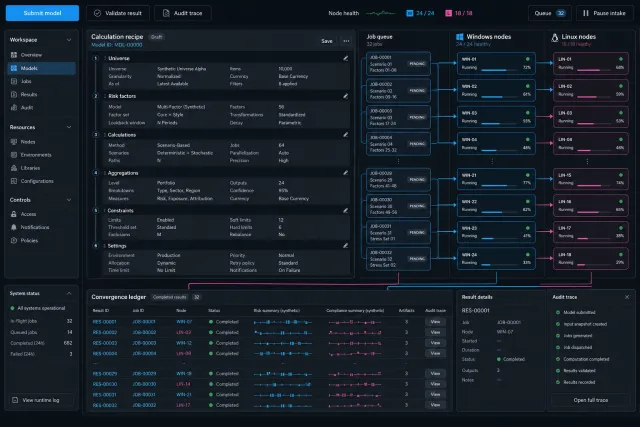
A distributed computation layer connected financial models, Windows and Linux grid nodes, and a familiar workbook interface for demanding risk and compliance calculations.
The situation
Financial-services teams were using sophisticated modelling, trading, and risk-management software to solve calculation-heavy risk and compliance problems.
The client interface had to remain familiar while demanding workloads moved to distributed compute nodes behind it.
The challenge
The work combined advanced C++ engineering, cross-platform execution, and clear result presentation.
Template metaprogramming, design patterns, Boost, and quantitative libraries required deep implementation expertise.
Server-side computation had to operate consistently across Windows and Linux nodes.
Distributed calculations still needed to return through a clear modelling and review experience.
The solution
The implementation wrapped computation processes on each node and linked the grid back to the modelling interface over SOAP.
Wrap the command-line calculation application in daemon processes that can run on each grid node.
Instantiate workbook automation objects inside the C++ client and submit work through a defined service contract.
Collect results from the distributed nodes and present them in a reviewable client workflow.
How the work was structured
Cross-platform behavior was implemented at the node-service layer instead of forcing users to manage individual environments.
Service communication provided a stable boundary between the modelling client and the distributed calculation processes.
Iterative delivery and validation kept milestones, model behavior, and output presentation aligned.
Prepare the model and calculation inputs.
Send jobs to available grid nodes.
Run work across Windows and Linux.
Return and validate the results.
The result
The documented engagement met its delivery milestones and established a maintainable foundation for continuing application work.
Calculation workloads could run away from the user interface without breaking the modelling journey.
Windows and Linux nodes participated in the same execution model.
The resulting architecture supported continuing enhancement and maintenance.
Case taxonomy
Give complex models the compute path they need
Get in touch
Tell us what you need to build, modernize, automate, or augment with AI. We can start with a focused discussion or a no-risk 1-week trial.

“A fantastic company to work with.” After the initial rapid development project, American Shipping Co. kept two Shinetech developers embedded for nearly four years, supporting internal and external tools and new AI initiatives.
 CEO, American Shipping Co. - 5-star Google Review