

E-commerce · Customer Data case study

Connecting customer identity, segments, and service with Salesforce

Shinetech connected online and store customer activity in Salesforce Data 360, then used purchase history and buying frequency to inform customer segments. Those segments supported different product recommendations, while service could see selected purchase context.

  • Salesforce
  • Data 360
  • Identity matching
  • Segmentation

The situation

The same promotion could reach customers with very different buying habits

Retail marketing needs to distinguish a first-time buyer, a regular customer and someone whose purchasing has slowed. Separate online and store records can hide those differences, leaving teams with broad campaign lists instead of a useful view of buying behavior.

Service needed the same purchase context

When a customer contacted the service team about a purchase, the agent needed the relevant activity beside the case. The project therefore had to connect records carefully before either customer analysis or service used them.

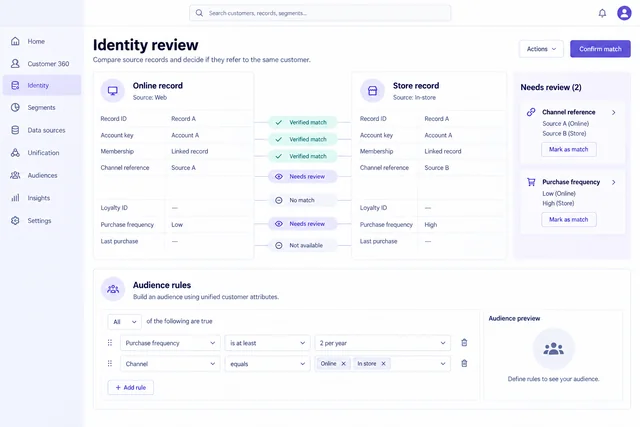
Customer identity review with source-record comparisons and an audience-rule editor.
Illustrative Salesforce-style interface with synthetic sample content. It depicts the described workflow, not the actual client system or a standard product screen.

The challenge

Turn buying behavior into a useful next marketing decision

The business needed to decide which customers should receive which kind of follow-up. Moving data between systems was one part of the work; usable segments also required reliable customer relationships and agreed definitions of purchases and returns. Purchase recency, frequency and value can help distinguish those needs, but the analysis depends on linking the right customer records and interpreting purchases and returns consistently. A useful segment needs both a clear definition and a purpose in customer communication.

The solution

Data 360 connected behavior to usable customer groups

Shinetech mapped online account and store membership identifiers into Data 360 matching rules. Verified relationships supported a shared view; uncertain records stayed available for review rather than being joined by similar names alone.

Purchase history and buying frequency informed customer segments. Different segments could then guide different product recommendations. The agreed purchase and return definitions remained attached to the analysis, and Service Cloud received selected purchase context for customer conversations.

Workflow detail

Where connected data informed customer decisions

Connected purchase activity supports customer analysis and selected service context. Each source keeps responsibility for its operational records.

Workflow detail

Purchase activity became a segment decision

  1. 01

    Link the activity

    Keep the customer and purchase source references.

  2. 02

    Describe the behavior

    Use agreed purchase history and frequency definitions.

  3. 03

    Review the segment

    Check which customer group the behavior supports.

  4. 04

    Inform the next use

    Use the segment for differentiated recommendations and selected service context.

Returns can change the behavioral view; communication preferences still govern any later outreach.

Workflow detail

How customer groups can guide different recommendations

Illustrative RFM-style planning examples, not the client’s exact segments or campaign rules. Recency describes how recently a customer purchased, frequency how often, and monetary value how much they spent.

Behavior to examineBusiness questionPossible follow-up
A recent first purchaseWhat would help this customer make a relevant next purchase?Recommend a related category where product and preference data support it.
Frequent purchases over timeWhich interests and purchase patterns deserve a different offer?Use category history to make the recommendation more relevant.
Previously active, with no recent purchaseIs a renewed recommendation appropriate?Review a re-engagement message against purchase history and communication preferences.

How we work

Check the identity, segment and business use together

The delivery method starts with the marketing decision: what customer behavior should lead to a different recommendation? Data owners then agree which source records can be linked, the purchase measures to use and how returns affect them. Identity matching supports that business decision.

Review follows a sample customer from purchase activity into a segment and its intended marketing use. It also checks the selected purchase information available to service staff. Uncertain matches and changed purchase history should remain explainable to the people using the data.

The result

Connected activity supported distinct customer decisions

Marketing

Purchase behavior provides a basis for customer segments and differentiated product recommendations, with the matching and measure rules available to review.

Service

Agents see selected purchase activity beside the request, with its source and refresh context.

Case taxonomy

Explore the industry, technology, and business need.

Industry and product

  • Retail
  • E-commerce

Technology and delivery

  • Salesforce Data 360
  • Marketing Cloud
  • Service Cloud

Business need

  • Identity Matching
  • Customer Segmentation
  • Recommendations
  • Service Context

Discuss your business systems

Need Salesforce to fit the way your team works?

Talk to our team

Get in touch

Ready to build software that fits your business?

Tell us what you need to build, modernize, automate, or augment with AI. We can start with a focused discussion or a no-risk 1-week trial.

“A fantastic company to work with.” After the initial rapid development project, American Shipping Co. kept two Shinetech developers embedded for nearly four years, supporting internal and external tools and new AI initiatives.
Marc Greenberg testimonial portrait Marc GreenbergCEO, American Shipping Co. - 5-star Google Review

Response within 1 business day.