Privacy between participants
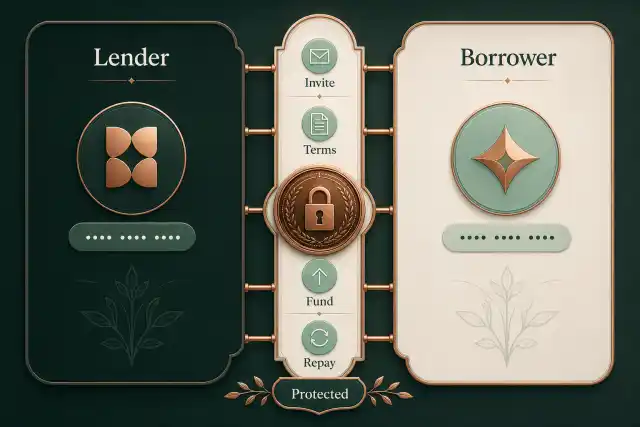
The lender and borrower needed to transact without exchanging account numbers directly.


Fintech case study
A financial product provider needed a safe way for family and friends to arrange personal loans through email while keeping account details private and working with established bank and card infrastructure.
The situation
The product concept allowed family and friends to lend to one another using an email-based interaction instead of directly exchanging bank account information.
To make that model credible, the application needed to connect to established financial infrastructure, protect sensitive data, capture accurate transaction information, and accommodate additional applications over time.
The product challenge
The business workflow and technical architecture both had to enforce trust across identity, relationship, terms, funding, and repayment.
The lender and borrower needed to transact without exchanging account numbers directly.
Use cases, data capture, fraud controls, and transport protection had to reinforce one another.
The platform needed a cost-conscious open architecture that could run across server environments and support future applications.
The solution
Detailed use-case and security design guided an open technology stack built around Struts, Spring, Hibernate, MySQL, and SSL.
Model invitation, agreement, funding, repayment, data capture, and exception paths as connected use cases.
Use MVC and Spring-managed components to separate controllers, business objects, and views for clearer testing and change.
Combine SSL, fraud-prevention controls, and existing bank and card infrastructure without exposing account details to participants.

How we worked
The team developed detailed use cases around both the lending process and the security expectations attached to each step.
Architecture decisions separated presentation, business logic, persistence, and data so individual layers could be tested and extended.
Open technologies supported compatibility and cost control, while SSL and fraud controls addressed the specific trust requirements of personal lending.
Define user, transaction, and security use cases.
Create clear presentation, business, and data layers.
Apply SSL and fraud controls across the transaction.
Preserve room for additional financial applications.
The result
The application enabled lender and borrower workflows without direct account-number sharing and provided a layered technical foundation for secure transactions and later product expansion.
The product connected invitation, terms, funding, and repayment instead of treating the loan as a single transfer.
Spring, Struts, Hibernate, and MySQL provided a portable foundation without collapsing application layers.
System security, business rules, transport encryption, and fraud prevention worked as a coordinated model.
Case taxonomy
Build trust into the transaction
Get in touch
Tell us what you need to build, modernize, automate, or augment with AI. We can start with a focused discussion or a no-risk 1-week trial.

“A fantastic company to work with.” After the initial rapid development project, American Shipping Co. kept two Shinetech developers embedded for nearly four years, supporting internal and external tools and new AI initiatives.
 CEO, American Shipping Co. - 5-star Google Review