Core platform context
Engineers needed a working understanding of the architecture and card-servicing rules.


Financial services case study
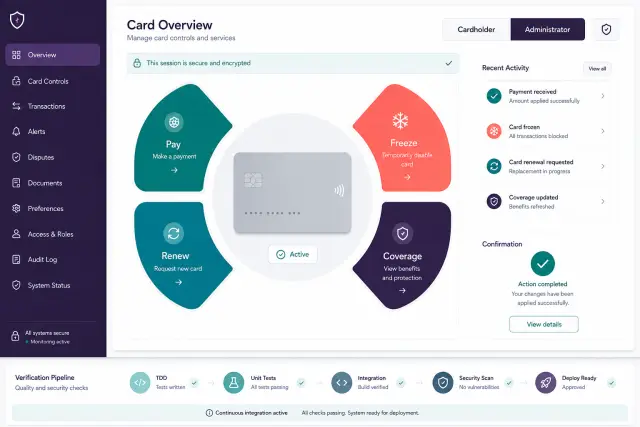
A financial-services product team needed additional engineering capacity for secure cardholder and administrator workflows across payments, freezing, renewals, and related coverage services.
The situation
The client’s internal developers and testers needed additional capacity during core platform development.
The extension team had to understand the architecture, card-servicing behavior, and quality practices before contributing to payment, freeze, renewal, and coverage functions.
The challenge
Capacity alone was not sufficient; the team had to align with architecture, security, testing, and release practices.
Engineers needed a working understanding of the architecture and card-servicing rules.
Payment, freezing, renewal, and coverage functions required dependable controls and confirmation paths.
External work had to fit the client’s TDD, continuous-integration, and Agile delivery model.
The solution
The team joined the existing engineering process rather than creating a separate offshore workflow.
Review the platform, card-servicing behavior, and the client’s delivery responsibilities.
Use Spring, Hibernate, PostgreSQL, Maven, Jenkins, and related tooling for approved work.
Apply test-driven development and continuous integration before changes move forward.
How the work was structured
Knowledge transfer supplied the context needed to work inside the core platform rather than around it.
TDD made expected card behavior visible before implementation details became fixed.
Continuous integration kept external contributions inside the same build and verification process as client-owned work.
Transfer architecture and workflow context.
Express expected behavior through tests.
Implement approved card services.
Verify through the shared pipeline.
The result
The documented engagement connected new engineering capacity with the client’s established architecture, TDD, continuous-integration, and Agile practices.
Architecture and business context were transferred before the team expanded its contribution.
Tests and integration status were part of each change rather than a separate final phase.
Work used one Agile process instead of parallel delivery systems.
Case taxonomy
Add capacity inside the existing quality system
Get in touch
Tell us what you need to build, modernize, automate, or augment with AI. We can start with a focused discussion or a no-risk 1-week trial.

“A fantastic company to work with.” After the initial rapid development project, American Shipping Co. kept two Shinetech developers embedded for nearly four years, supporting internal and external tools and new AI initiatives.
 CEO, American Shipping Co. - 5-star Google Review