Interaction between modules
The step menu had to trigger saving and navigation in the primary design module without creating brittle flow control.


Product configuration case study
A software provider needed two coordinated modules that would let customers design and book a configurable windscreen online while administrators managed multilingual page content and email templates.
The situation
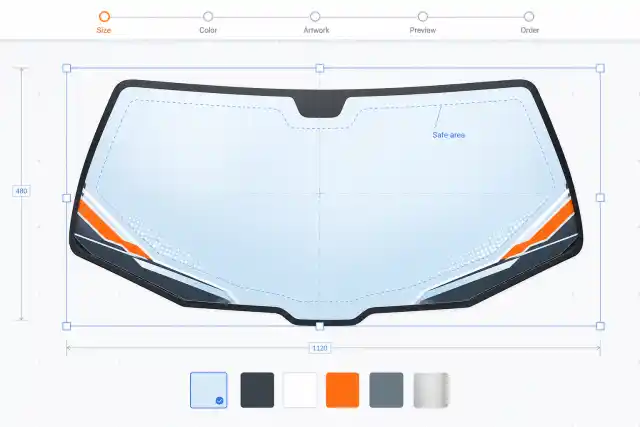
The primary design module needed to guide users through size, color, logos, text, description, preview, and booking. A separate step-menu module needed to save progress, switch stages, and display a summary for each step.
The broader scope also included scheduling, email, data access, order generation, e-commerce, and multilingual content—making module coordination and dynamic language settings the central technical challenges.
The product challenge
The experience needed the flexibility of independent platform modules without exposing that separation to customers or administrators.
The step menu had to trigger saving and navigation in the primary design module without creating brittle flow control.
Administrator-managed page copy and email templates could not rely on static source-language resources.
Design, booking, scheduling, email, data access, e-commerce, and order generation all had to contribute to one coherent path.
The solution
The primary module handled design and booking while the step module managed stage switching and summaries. The implementation used generated .NET callbacks to coordinate saves and navigation without complex flow control.
Break size, color, artwork, text, description, preview, and booking into understandable steps.
Use lightweight client-side scripts and .NET callbacks for saving and stage changes.
Give administrators language controls for page documents and email templates that could not be translated through static code alone.

How we worked
The team mapped the design and booking flow across the step menu and primary module before selecting a simple coordination approach.
Development covered the wider DotNetNuke ecosystem, including scheduling, email, the data-access layer, product design, order management, and e-commerce behavior.
Alpha testing and defect correction verified how the separate modules and multilingual settings behaved as one end-to-end product.
Capture size, color, artwork, text, and description.
Save and navigate across the two modules.
Manage dynamic content and email by language.
Preview, book, schedule, and generate the order.
The result
The implemented modules connected step-by-step configuration, persistent summaries, preview, booking, scheduling, email, e-commerce, order generation, and administrator-managed multilingual content.
Customers could define product attributes step by step and preview the configuration as it evolved.
Client-side coordination let the step menu and design module behave as a unified product.
Administrators could manage language-specific documents and email templates as dynamic content.
Case taxonomy
Turn configuration into a complete journey
Get in touch
Tell us what you need to build, modernize, automate, or augment with AI. We can start with a focused discussion or a no-risk 1-week trial.

“A fantastic company to work with.” After the initial rapid development project, American Shipping Co. kept two Shinetech developers embedded for nearly four years, supporting internal and external tools and new AI initiatives.
 CEO, American Shipping Co. - 5-star Google Review