An owned product
The client gained a clinical application it could develop and offer to practices under its own product direction.


Healthcare · Clinical records
A healthcare software provider moved from reselling other products to building its own clinical application, starting with patient records and notes and expanding into document exchange and prescribing integration.
The business context
Selling and supporting healthcare software gave the client direct exposure to how independent practices work. It also left important product decisions with another vendor: which workflows could change, how features evolved, and what the provider could offer its customers. The business wanted to build an electronic medical record product of its own.
The first investment was deliberately focused. Shinetech built a desktop MVP around patient information and encounter notes so the client could assess the core workflow and the development partnership. Acceptance of that initial application led to continued work on a commercial product for clinics.
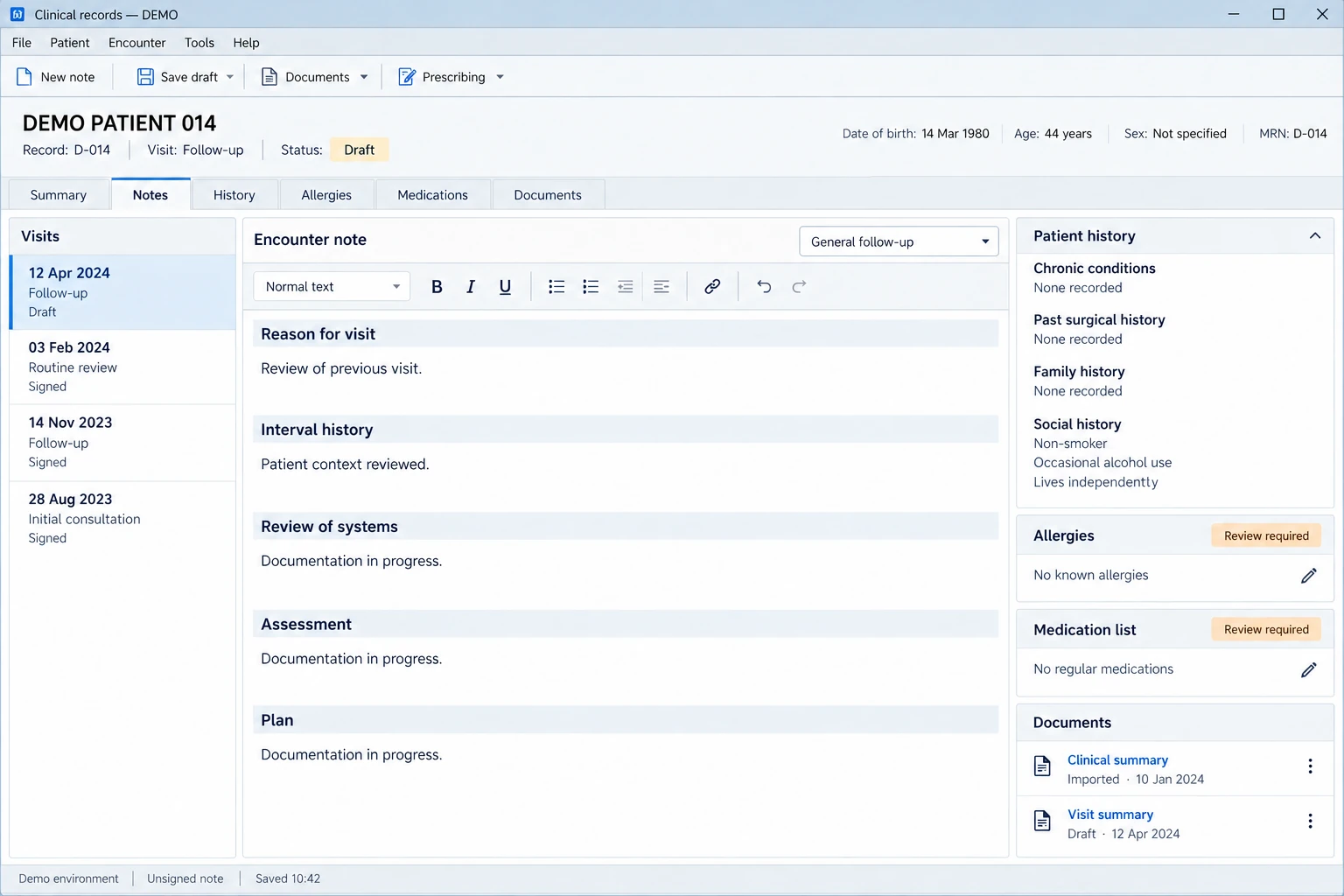
The encounter note is the main work surface, with patient context close at hand. This is a reconstructed desktop interface with a fictional patient and demonstration text, not a clinical record or treatment recommendation. View full-size interface (new tab)
The operating challenge
Writing a note is a repeated task, but it does not look the same in every specialty. A rigid template can be a poor fit for the clinician’s work; an entirely free-form document can leave important patient information disconnected. The product needed configurable note structures alongside accessible history, allergies, medications, and health-management information.
The same patient record also had to communicate beyond the application. An incoming clinical document is useful only if its information is interpreted and mapped into the appropriate record. Sending information requires the reverse process. The work therefore involved both the everyday note-writing experience and the structured data behind it.
The delivery decisions
The MVP established patient management and clinical notes in a desktop application. Subsequent development extended the surrounding record and query capabilities. This gave the client a concrete product to evaluate and evolve, instead of committing the initial scope to every possible clinic-management function.
Shinetech developed the notes module with configurable templates and formatting for different specialties and encounter types. Notes work with the patient’s existing context, including history, allergies, and medications. The design challenge was to support clinicians’ different documentation habits while keeping the note part of a coherent patient record.
The team implemented generation and parsing of standardized clinical documents, mapping received information to the application’s patient data. A third-party electronic prescribing integration extended the workflow. That work depended on the external service’s interface requirements and coordination during integration, alongside continued development of the core record.
How the workflow holds together
The commercial step was more than adding features to a prototype. The provider needed an application it could continue to sell and support as clinic requirements evolved. Development therefore continued around the desktop product, its data, and its integrations, with work tracked remotely and discussions arranged when needed.
The note-writing workflow remained a useful center of gravity. A clinician opens a patient record, reviews the relevant context, and documents an encounter. Templates, document exchange, and prescribing are valuable because they support that work. This kept the product story connected to the practices the client served rather than to a list of unrelated modules.
The delivered result
The client gained a clinical application it could develop and offer to practices under its own product direction.
Configurable notes work with patient history, allergy, and medication information.
Structured document exchange and prescribing integration extend the patient-record workflow.
The product continues to receive maintenance. This case describes software delivery and commercialization; it does not claim clinical outcome improvements or certification work beyond the documented scope.
Case taxonomy
Discuss your project
Tell us how your business works and where your software needs to change.
Get in touch
Tell us what you need to build, modernize, automate, or augment with AI. We can start with a focused discussion or a no-risk 1-week trial.

“A fantastic company to work with.” After the initial rapid development project, American Shipping Co. kept two Shinetech developers embedded for nearly four years, supporting internal and external tools and new AI initiatives.
 CEO, American Shipping Co. - 5-star Google Review