Online intake
Customers could submit loan information through the portal instead of relying solely on staff to re-enter emailed applications.


Financial Services · Mortgage workflow modernization
A mortgage business added customer and employee web portals around an established desktop system, using field-level change tracking and COM integration to preserve existing loan-processing logic.
The business context
Borrowers and channel customers sent application information to staff, who entered it into a desktop application. The existing website did not connect to that working environment. For employees, access also depended on having the licensed software installed on the machine they used.
The client wanted a browser-based way to receive applications and carry out internal loan work while retaining the business logic already in use. The commercial need was a broader, more adaptable working model; a complete rewrite of the old application was not a prerequisite.
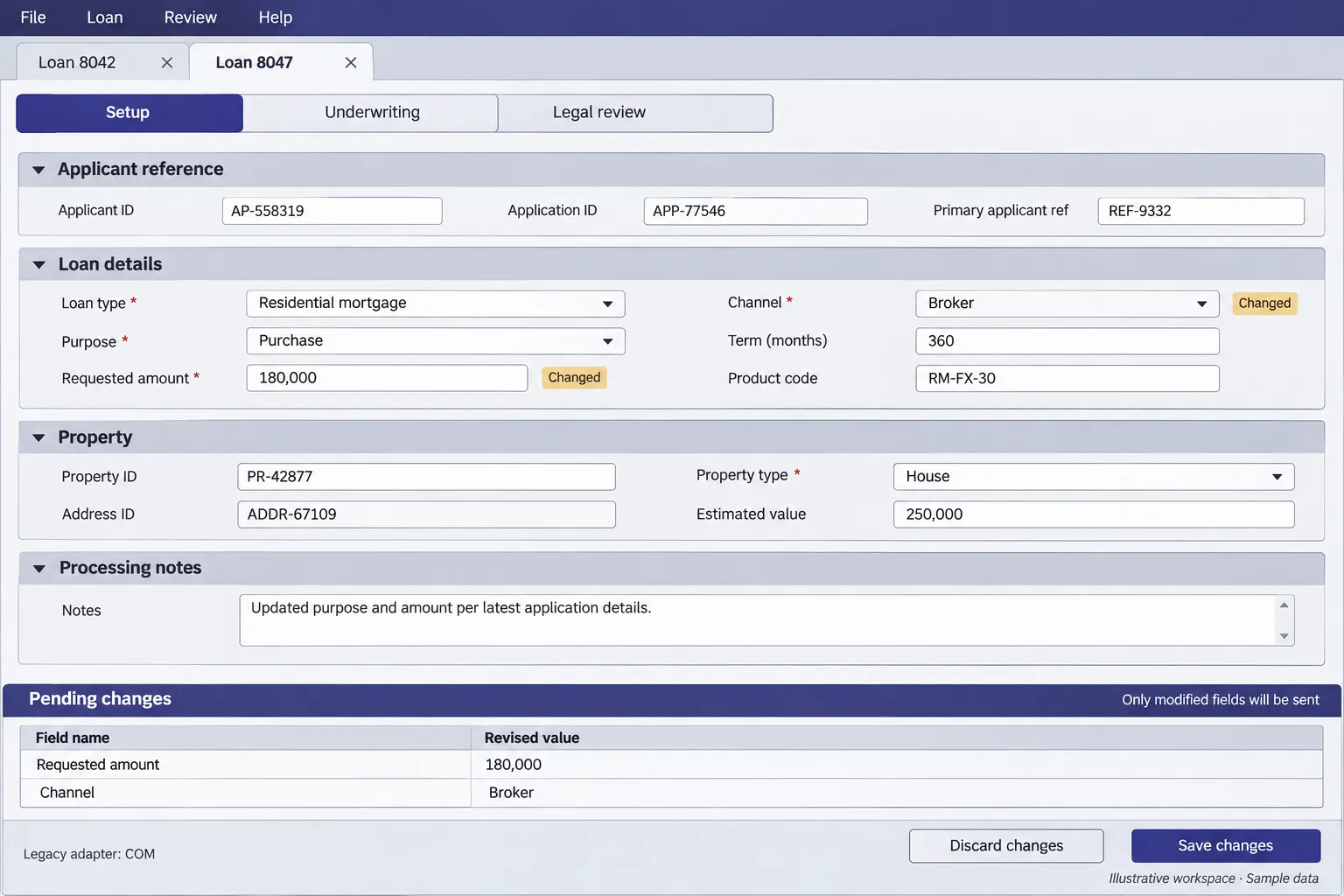
Illustrative employee record with fictional loan references, amounts, and edited fields. The pending-change panel explains the adaptation approach; it is not a client screenshot or a loan decision. View full-size interface (new tab)
The operating challenge
The desktop application exposed COM interfaces and used a record-oriented update process: open the data, locate a record, change fields, and save. A web page needed to express its edits in a form that this existing process could handle. Legacy and third-party interface documentation was incomplete or did not always match observed behavior.
The web platform also served different roles. External customers needed an application path, while internal setup, underwriting, legal review, and operating teams needed their own access and functions. Shared loan information had to remain usable across those working contexts.
The delivery decisions
The customer portal supported online applications, loan-program selection, and rate-lock requests. The employee portal used role-based access for internal processing and administration, with authentication integrated into the client's identity environment.
The web layer tracked edited records and fields. On save, it assembled those changes for the backend to convert into the legacy application's expected operations and call through COM. This reused the established update logic without submitting every unchanged field.
A separate pricing engine accepted loan information and the selected program, then returned eligibility and, where applicable, reasons for a mismatch. Shared functions were reused across internal modules rather than implemented independently in each working area.
The working detail
The useful handoff was a list of changed fields associated with the correct records. The backend could translate that list into the sequence the desktop application understood. The design preserved the legacy data-operation model while allowing staff to work through web forms.
Delivery used jointly reviewed user stories and test points, developer checks, UAT verification, and regression testing after affected changes reached production. New functionality could be introduced in the web layer alongside existing desktop capabilities; the project did not require every business rule to move at once.
The delivered result
Customers could submit loan information through the portal instead of relying solely on staff to re-enter emailed applications.
Employees could carry out supported loan tasks through role-based web functions connected to the existing application.
COM integration and the field adapter reused established business behavior while the web platform continued to evolve.
The delivered platform combined customer and employee portals, a pricing component, and legacy integration. It continued through feature development and maintenance while retaining the existing desktop application's business capabilities.
Case taxonomy
Discuss your project
Tell us how your business works and where your software needs to change.
Get in touch
Tell us what you need to build, modernize, automate, or augment with AI. We can start with a focused discussion or a no-risk 1-week trial.

“A fantastic company to work with.” After the initial rapid development project, American Shipping Co. kept two Shinetech developers embedded for nearly four years, supporting internal and external tools and new AI initiatives.
 CEO, American Shipping Co. - 5-star Google Review