Call-to-mailbox routing
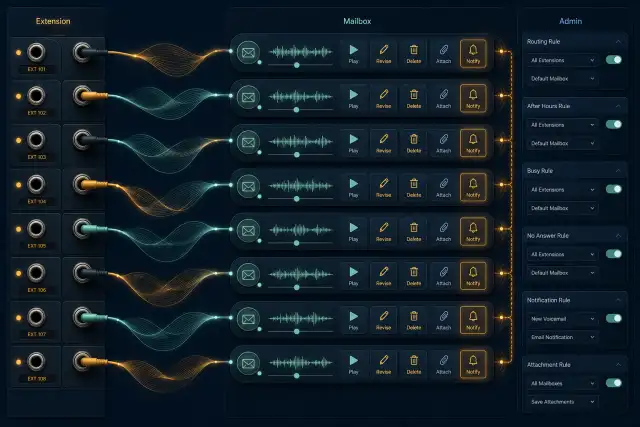
Each extension needed a corresponding mailbox and defined behavior when the owner did not answer.


Telecommunications case study
A call-handling provider needed to replace manual message operations with a voicemail platform that could answer calls, store recordings, notify users, and provide personal and administrative web access.
The situation
The provider wanted a voicemail application integrated with call management. Each extension needed its own mailbox and prerecorded answer, while incoming messages had to become stored voice records available to the right user.
Mailbox owners also needed to review and manage messages from the web, receive email notifications, and access playback when an IP phone was not available.
The challenge
The system had to coordinate call answering and stored media while keeping each extension's messages separate.
Each extension needed a corresponding mailbox and defined behavior when the owner did not answer.
Users needed playback and practical message actions without depending on the original phone.
Mailbox owners and administrators required different browser-based controls.
The solution
The team translated business requirements into a technical specification and built the product incrementally around telephony, media, mailbox, and web components.
Route unanswered calls to the matching mailbox, play the recorded greeting, and store the voice message on the server.
Support playback and message actions through the phone context, media player, and browser.
Send email when new messages arrive and provide web controls for mailbox owners and system administrators.
How we worked
Requirements discussions established how unanswered calls, greetings, mailboxes, recordings, and notifications should interact.
Logical design and technical specifications separated telephony integration from media handling, web access, and persistent data.
Incremental development made it possible to validate the core message path before layering on broader mailbox and administrative functions.
Define call, mailbox, recording, and access behavior.
Separate telephony, media, web, and data responsibilities.
Connect extensions, mailboxes, playback, and notifications.
Give users and operators appropriate web controls.
The result
The documented system connected call answering, individual mailboxes, voice storage, playback, notifications, and web administration.
Calls could be answered and recorded even when the extension owner was unavailable.
Email notifications alerted mailbox owners when new messages arrived.
Users and administrators could manage the system through browser-based interfaces.
Case taxonomy
Connect calls with action
Get in touch
Tell us what you need to build, modernize, automate, or augment with AI. We can start with a focused discussion or a no-risk 1-week trial.

“A fantastic company to work with.” After the initial rapid development project, American Shipping Co. kept two Shinetech developers embedded for nearly four years, supporting internal and external tools and new AI initiatives.
 CEO, American Shipping Co. - 5-star Google Review