Instrument coordination
Scanning and rapid spectral image acquisition required consistent parameter and device control.


Materials-science AI case study
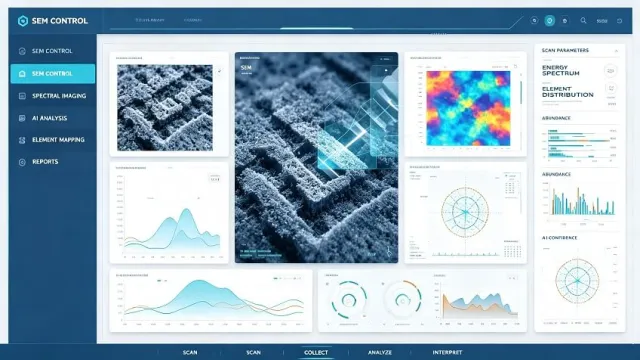
An intelligent scanning-electron-microscope workflow coordinated spectral acquisition, elemental identification, abundance mapping, analysis, and reporting.
The situation
Scanning-electron-microscope acquisition produced rich spectral imagery that required careful analysis to identify elemental distribution and abundance.
Researchers needed a repeatable path from scan setup through interpretation and reporting.
The challenge
The system needed to manage both physical acquisition and the analytical workflow that followed.
Scanning and rapid spectral image acquisition required consistent parameter and device control.
Elemental distribution and abundance had to be extracted from dense experimental signals.
Capture, interpretation, and reporting needed a workflow that could be reviewed and repeated.
The solution
The application treated acquisition and analysis as connected stages instead of separate tools.
Coordinate microscope operation and spectral image acquisition through one interface.
Use neural-network-assisted methods to identify distribution and abundance patterns.
Present spectral images, maps, analysis views, and research outputs in a repeatable workflow.
How the work was structured
Scan settings and instrument states remained visible alongside captured material imagery.
Element maps and abundance views stayed connected to the sample context.
Automated processing reduced handoffs while preserving review steps for researchers.
Acquire material and spectral imagery.
Organize signals and parameters.
Identify elemental distribution.
Review abundance and report.
The result
The documented platform automated the transitions between scanning, spectral analysis, visualization, and research review.
Scan parameters and source imagery remained part of the analytical record.
Element distribution and abundance were organized into reviewable views.
Scanning, analysis, interpretation, and reporting formed one repeatable process.
Case taxonomy
Connect scientific instruments to intelligent analysis
Get in touch
Tell us what you need to build, modernize, automate, or augment with AI. We can start with a focused discussion or a no-risk 1-week trial.

“A fantastic company to work with.” After the initial rapid development project, American Shipping Co. kept two Shinetech developers embedded for nearly four years, supporting internal and external tools and new AI initiatives.
 CEO, American Shipping Co. - 5-star Google Review