Realistic practice
Virtual patient interviews had to support scenario-based diagnostic reasoning.


Medical education AI case study
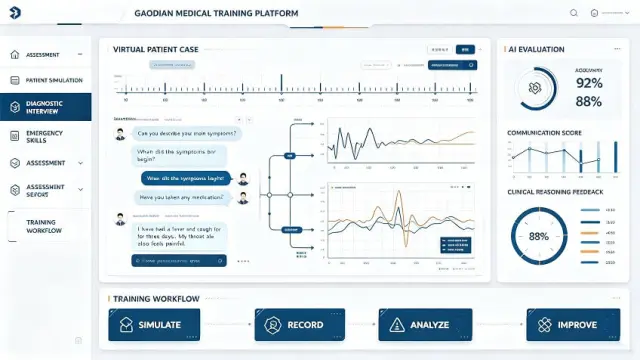
A training platform combined simulated patient interviews with video-based assessment of emergency-care procedures to make practice more repeatable and feedback more structured.
The situation
Learners needed repeatable opportunities to practice diagnostic conversations without depending on a single live scenario.
Educators also needed a structured way to review posture, movement, and procedure sequence from recorded emergency-care practice.
The challenge
Conversation practice and physical-skills review required different AI capabilities inside one learning workflow.
Virtual patient interviews had to support scenario-based diagnostic reasoning.
Recorded procedures required posture, movement, and sequence analysis.
Evaluation needed to identify specific errors and improvement areas without replacing educator judgment.
The solution
The platform supported both conversational reasoning and video-based procedure review.
Create repeatable conversations and scenario-based diagnostic practice.
Use vision models, neural networks, pose recognition, and process evaluation on recorded practice.
Highlight detected deviations and assessment signals for learner and educator review.
How the work was structured
Conversational scenarios focused on information gathering and clinical reasoning rather than physical technique.
Video analysis focused on observable posture, movement, and workflow sequence rather than interpreting a learner’s intent.
Feedback combined the signals into a reviewable training record instead of presenting an unsupported clinical conclusion.
Run a repeatable patient scenario.
Capture procedural practice.
Review motion and process signals.
Return structured feedback.
The result
The documented product connected simulated interviews, recorded practice, AI analysis, and feedback in one training process.
Scenario-based interviews could be revisited under consistent conditions.
Procedure review focused on recorded movement and workflow sequence.
Assessment signals supported learning rather than replacing educator judgment.
Case taxonomy
Turn training activity into reviewable evidence
Get in touch
Tell us what you need to build, modernize, automate, or augment with AI. We can start with a focused discussion or a no-risk 1-week trial.

“A fantastic company to work with.” After the initial rapid development project, American Shipping Co. kept two Shinetech developers embedded for nearly four years, supporting internal and external tools and new AI initiatives.
 CEO, American Shipping Co. - 5-star Google Review