Changing contours
Droplet boundaries varied across experimental images and needed reliable measurement.


Fluid-mechanics AI case study
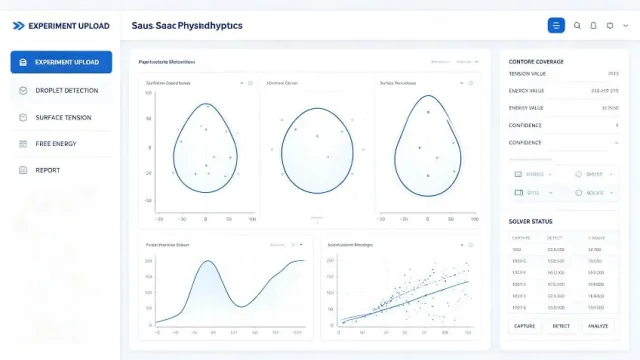
A physics-informed analysis workflow connected experimental imagery, droplet-contour detection, surface-tension and free-energy calculations, equation solving, and repeatable reporting.
The situation
Researchers needed to detect changing liquid-surface contours accurately and relate those measurements to surface tension and free energy.
Complex partial differential equations also had to be solved consistently as part of the same analytical process.
The challenge
Contour detection, physical calculation, equation solving, and repeatability all had to remain reviewable.
Droplet boundaries varied across experimental images and needed reliable measurement.
Partial differential equations required efficient numerical treatment grounded in the physical problem.
Capture, calculation, and reporting needed a consistent workflow across experiments.
The solution
The application joined image-based measurement and physics-informed modelling rather than treating them as separate research tools.
Use computer vision to identify and measure the liquid-surface boundary in experimental imagery.
Calculate surface tension and free energy from the captured measurements.
Use physics-informed neural networks for equation solving and organize the results for review.
How the work was structured
Source images and detected contours stayed visible together for review.
Equation-solving steps remained connected to the measurements and physical quantities they represented.
Reusable capture and reporting stages made repeated experiments easier to compare.
Receive experimental imagery.
Measure the droplet contour.
Calculate physical behavior.
Review and record the result.
The result
The documented application connected visual detection, physical calculation, equation solving, and reporting in one experimental workflow.
Detected boundaries remained connected to the source imagery.
Surface tension, free energy, and equation solving operated in one workflow.
Capture, analysis, and reporting followed the same sequence.
Case taxonomy
Connect experimental evidence to applied AI
Get in touch
Tell us what you need to build, modernize, automate, or augment with AI. We can start with a focused discussion or a no-risk 1-week trial.

“A fantastic company to work with.” After the initial rapid development project, American Shipping Co. kept two Shinetech developers embedded for nearly four years, supporting internal and external tools and new AI initiatives.
 CEO, American Shipping Co. - 5-star Google Review