Late feedback
Phase-end delivery delayed the point at which changed expectations became visible.


Business software case study
A distributed team replaced phase-end delivery with shorter increments, demonstrations, and visible change decisions when requirements repeatedly shifted.
The situation
The product was initially organized around a waterfall model with delivery at the end of a development phase.
As requirements changed, the team needed a way to expose work earlier and make adjustments before another large phase was complete.
The challenge
The delivery problem was one of timing, visibility, and communication rather than a documented end-user feature gap.
Phase-end delivery delayed the point at which changed expectations became visible.
New requirements could affect work completed in an earlier phase.
Several teams needed shared visibility into current decisions and increments.
The solution
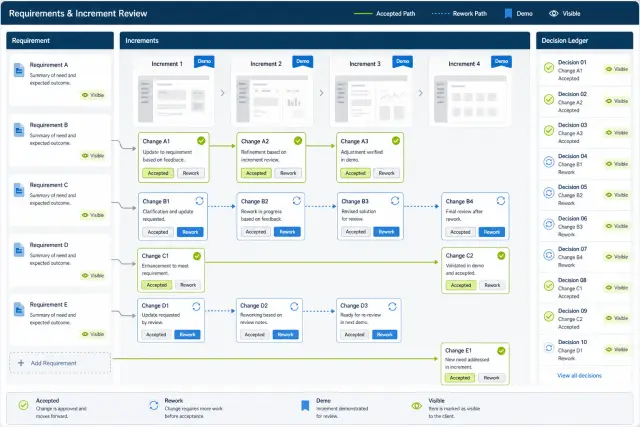
The team shifted from a phase-end handoff to frequent delivery, review, and communication.
Break the work into smaller increments that could be demonstrated earlier.
Use shared project visibility so the client could follow the work and requirement changes.
Keep delivery teams and the client closely connected as requirements evolved.
How the work was structured
The original waterfall plan was replaced with recurring increments and product demonstrations.
Feedback and changed requirements were incorporated into the next reviewable unit of work.
Shared visibility helped the distributed participants follow what had been accepted and what required revision.
Clarify the current requirement.
Build a smaller reviewable increment.
Expose the work and gather feedback.
Apply accepted changes to the next increment.
The result
The source documents the delivery-model change and the technologies involved; it does not describe the product's end-user feature set or measured business outcomes.
Demonstrations created checkpoints before another large phase was complete.
Changed expectations could shape the next increment of work.
No undocumented personal-information features or commercial results were added.
Case taxonomy
Make changing requirements reviewable
Get in touch
Tell us what you need to build, modernize, automate, or augment with AI. We can start with a focused discussion or a no-risk 1-week trial.

“A fantastic company to work with.” After the initial rapid development project, American Shipping Co. kept two Shinetech developers embedded for nearly four years, supporting internal and external tools and new AI initiatives.
 CEO, American Shipping Co. - 5-star Google Review